
The Devotional Rhythm of Assam
Sattriya
A living monastic tradition of grace and devotion, born in the sacred Sattras of Assam to celebrate the supreme love of Lord Krishna.
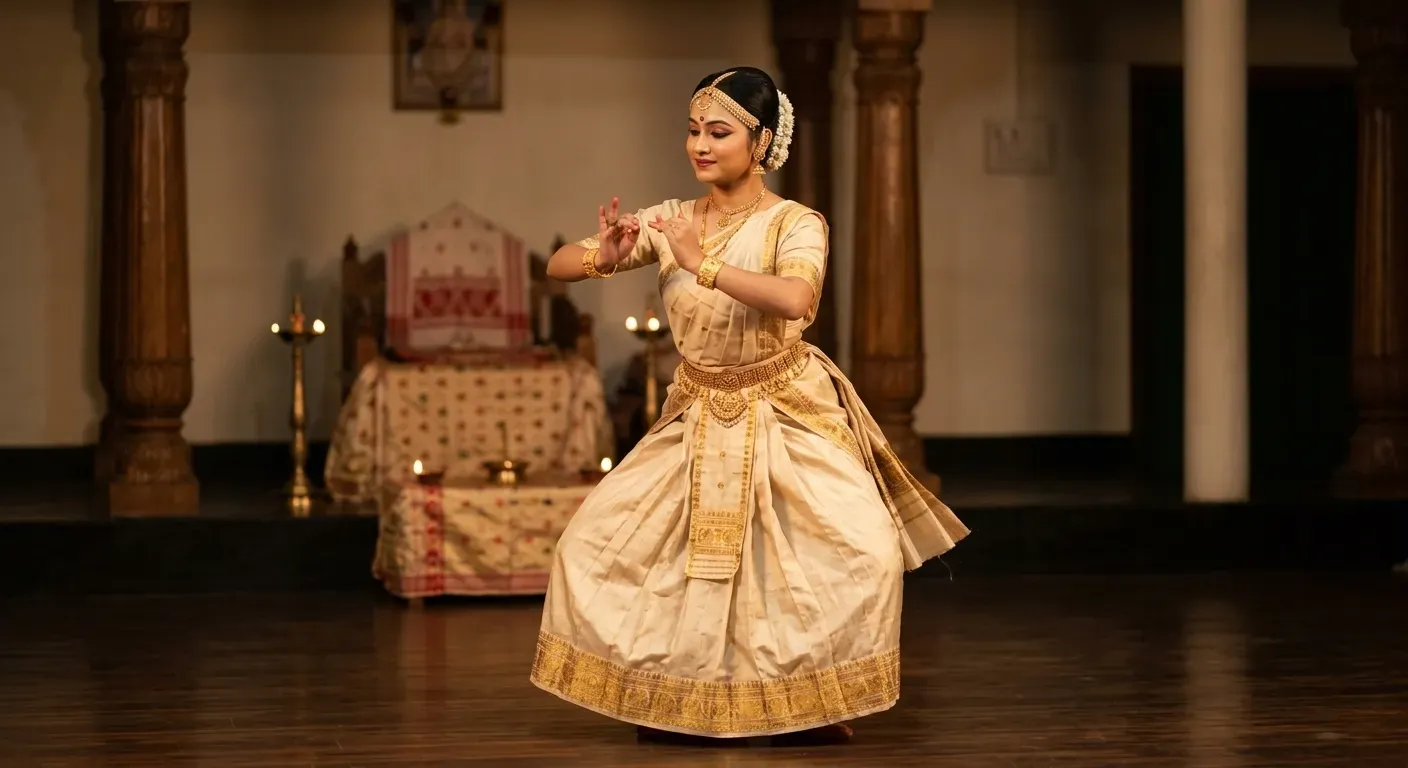
An artistic representation of Sattriya, the classical dance of Assam, performed in traditional Pat silk attire, capturing the essence of devotion and grace.
Origins & Spiritual Roots
The Monastic Offering of Majuli
In the 15th century, the great Vaishnava saint and social reformer, Mahapurush Srimanta Sankardev, breathed life into a profound art form. He did not merely create a dance; he forged a spiritual pathway. Sattriya was born deep within the sanctums of the Sattras (monasteries) of Assam, particularly echoing across the river island of Majuli. For centuries, celibate monks known as Bhokots preserved this sacred art as a daily ritualistic offering to Lord Krishna. It is a dance steeped in Bhakti Rasa—the ultimate devotion—where every movement is a prayer, transcending the physical body to connect directly with the divine.
Performance Structure
Mati Akhara and the Divine Play
The foundation of Sattriya technique begins with the Mati Akhara (ground exercises), which instill discipline, flexibility, and the distinct undulating grace characteristic of the form. A traditional performance unfolds gracefully, often beginning with the Gayan-Bayan—an invocation led by singers and drummers playing the sacred Khol. The repertoire balances Nritta (pure, rhythmic dance) and Nritya (expressive dance), beautifully culminating in the Ankiya Naat, the one-act plays written by Sankardev. Unlike the sharp geometric lines of the southern styles, Sattriya embraces fluid, circular, and wave-like movements, mirroring the gentle flow of the Brahmaputra river.
Aesthetics & Attire
Woven Elegance of Assam Silk
The visual grace of Sattriya is deeply rooted in Assamese heritage. Dancers adorn themselves in the exquisite, indigenous Pat (mulberry) silk. Male performers traditionally wear the dhoti, chadar, and a paguri (turban), while female dancers wear the elegant ghuri, chadar, and kanchi (waist belt). The ornamentation features traditional Assamese motifs, such as the Kopali on the forehead and Muthi Kharu bracelets. The resonant sounds of the Khol (asymmetrical drum) and the Bhortaal (large cymbals) guide the dancer's feet, creating a heavenly acoustic environment.
Visitor Guide
Witnessing the Grace
Best Places to Watch
The majestic river island of Majuli remains the spiritual heart of Sattriya. The annual Raas Mahotsav in November is an unparalleled experience.
Musical Style
Performed to Borgeet, classical devotional songs composed by Sankardev and Madhavdev, accompanied by the Khol, Taal, and Flute.
Mudras (Hand Gestures)
While sharing roots with the Natya Shastra, Sattriya utilizes its own distinct manual, the Sri Hastamuktavali, to articulate its spiritual narratives.
Spiritual Philosophy
Rooted entirely in Eka Sarana Nama Dharma—the worship of one supreme entity, Krishna. It focuses on submission, humility, and transcendental love.
Mukunda Murari...
Through the rhythm of the Khol and the grace of the body, we dissolve our ego and surrender completely to the lotus feet of the Lord.