
Shruti · Sacred Revelation · c. 1500 BCE & earlier
The Vedas
The breath of the eternal, caught in human language — the oldest surviving body of spiritual literature in the world.
Overview
The Fountain of All That Followed
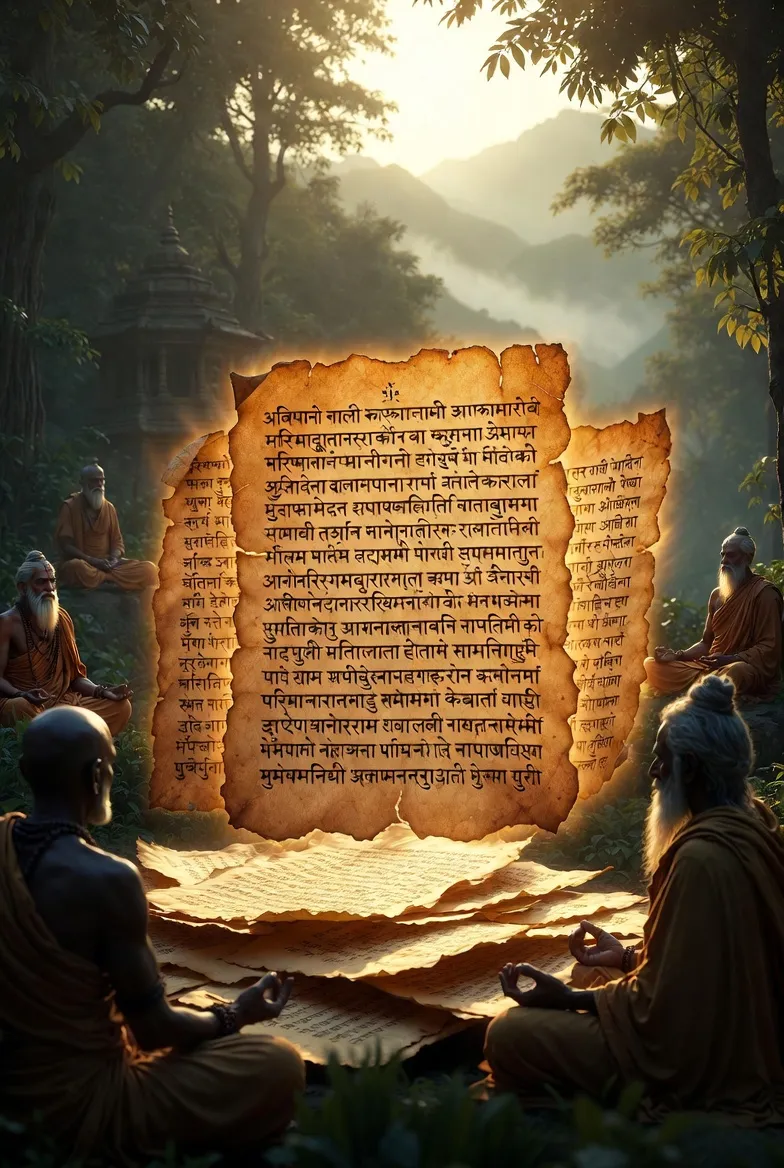
The Vedas are the earliest and most authoritative layer of Hindu sacred literature — classified as Shruti, meaning "that which was heard," to indicate that they were not composed by human minds but received by seers (rishis) in states of heightened inner perception and transmitted faithfully from generation to generation. There are four Vedas: the Rigveda, the Samaveda, the Yajurveda, and the Atharvaveda. Each is further divided into four parts: the Samhitas (collections of hymns and mantras), the Brahmanas (prose texts on ritual), the Aranyakas (forest treatises), and the Upanishads (philosophical dialogues). Together they constitute a universe of knowledge — spiritual, philosophical, ritual, medicinal, astronomical, and poetic — so vast that no single person or lifetime can encompass it.
The Vedas hold a position of unparalleled authority in the Hindu tradition. Every subsequent school of thought — whether philosophical, devotional, or ritual — has defined itself in relation to the Vedas, either drawing upon them, elaborating them, or in a few cases (as with Buddhism and Jainism) deliberately departing from them. To understand the Vedas is to understand the source from which the entire river of Indian civilisation flows.
The Four Vedas
A Library of Sacred Knowledge
The Rigveda is the oldest and most celebrated of the four. It contains 10,552 verses organised into 1,028 hymns across ten books (Mandalas), addressed primarily to the Vedic deities — Agni (fire), Indra (storms and warrior-power), Varuna (cosmic order), Surya (the sun), and many others. But beneath the polytheistic surface of these hymns runs a deeper philosophical current: the Rigveda contains some of the earliest recorded speculations on the origin of the cosmos, the nature of being, and the relationship between the human and the divine. Its most celebrated philosophical hymn, the Nasadiya Sukta (Hymn of Non-Creation), asks with breathtaking intellectual humility whether even the Creator knows how creation began. Read More →
The Samaveda is the Veda of melodies — almost entirely composed of verses drawn from the Rigveda but arranged for chanting in specific ritual contexts. It is the musical heart of the Vedic tradition and the source from which Indian classical music traces its deepest ancestry. Read More →
The Yajurveda provides the prose formulae (yajus) used by the officiating priests in the great Vedic sacrifices (yajnas) — a complex ritual science that formed the basis of Vedic social and spiritual life. Read More →
The Atharvaveda stands somewhat apart from the other three: it contains hymns, spells, charms, and medical knowledge of a more earthly character, including prayers for health, long life, protection from enemies, and the resolution of domestic problems — a window into the everyday spiritual concerns of ancient Indian society. Read More →
Transmission & Preservation
The Living Memory of a Civilisation
The most extraordinary fact about the Vedas is not their antiquity but their preservation. For thousands of years — long before writing was used to record sacred texts in India — the Vedas were transmitted entirely through memorisation, using a system of recitation techniques of such rigorous precision that modern scholars have confirmed the texts recited by trained Vedic priests today are virtually identical to those chanted millennia ago. This was achieved through the development of multiple recitation methods (pathas) designed to cross-check each other: if a word were incorrectly memorised in one pattern, the error would be exposed when the text was recited in the checking patterns. UNESCO has recognised the Vedic chanting tradition as an Intangible Cultural Heritage of Humanity — a living testament to the extraordinary power of disciplined oral transmission.
Each of the four Vedas was assigned to a specific priestly lineage responsible for its custody and transmission, and the tradition of Vedic recitation continues in parts of India today, carried by communities of trained brahmins who have dedicated their lives to the preservation of this ancient sound-heritage.
Spiritual Significance
Sound as the Fabric of Reality
The Vedic tradition holds that the mantras of the Vedas are not merely words with meanings — they are vibrations whose very sound-patterns carry transformative power. The word mantra derives from the Sanskrit roots manas (mind) and trana (liberation) — a mantra is that which liberates the mind. When correctly pronounced with the proper intonation, duration, and rhythmic pattern, a Vedic mantra is understood to resonate with the underlying frequencies of the cosmos, producing effects in the physical, vital, and mental dimensions of the person who recites it and the space in which it is recited.
This understanding gives Vedic chanting a dimension that purely literary or historical approaches cannot capture. The rishis who received the Vedic mantras were not poets crafting beautiful language — they were scientists of consciousness, working with sound as a primary medium of reality. The Vedas, in this sense, are not texts to be read but living transmissions to be entered through the ear and the body as much as through the intellect.
Key Facts
At a Glance
Number of Vedas
Four — Rigveda, Samaveda, Yajurveda, Atharvaveda
Classification
Shruti — directly revealed, not authored by humans
Language
Vedic Sanskrit — the oldest form of the Sanskrit language
Approximate Date
Rigveda: c. 1500 BCE or earlier; other Vedas followed over subsequent centuries
UNESCO Recognition
Vedic Chanting declared an Intangible Cultural Heritage of Humanity in 2008
Influence
Foundation of all subsequent Hindu philosophy, ritual, music, medicine, and cosmology
Rig Sama Yajur Atharva
May the eternal wisdom of the Vedas continue to illuminate the path of all who seek the truth.