
Char Dham · Saptagiri
Tirumala Venkateswara Temple
Atop seven sacred hills, the Lord of the Kaliyuga watches over his creation — and the world comes to his feet.
Overview
The Hill That the World Climbs
In the rolling hills of the Eastern Ghats in Andhra Pradesh, at an elevation of over eight hundred metres above the plains, sits the most visited pilgrimage destination on the face of the earth. The Tirumala Venkateswara Temple — known universally as Tirupati Balaji — receives between fifty thousand and a hundred thousand devotees on an ordinary day, and several times that number during festival periods. No other religious site anywhere in the world consistently draws such multitudes.
The deity enshrined here, Lord Venkateswara, is understood to be Lord Vishnu himself — the preserver and sustainer of the cosmos — who descended to the earth in the current age (Kaliyuga) to be accessible to humanity in its state of spiritual limitation. His very presence on these hills is regarded as an act of supreme compassion, and the faith that draws millions up the seven sacred peaks of Tirumala year after year speaks to a devotion that is both deeply personal and profoundly communal.
History
From Ancient Verse to Global Pilgrimage
The antiquity of worship at Tirumala is attested by the Alvars — the Tamil Vaishnava poet-saints who lived between the sixth and ninth centuries — whose devotional hymns in the Divya Prabandham celebrate Venkateswara with extraordinary passion. Inscriptions from the Pallava period confirm that the temple was already an established and prosperous centre of pilgrimage well over a thousand years ago.
The temple received substantial royal patronage across successive dynasties — the Pallavas, the Cholas, the Hoysalas, and above all the Vijayanagara emperors, who regarded Venkateswara as their presiding deity and made lavish donations that funded much of the temple's current architectural grandeur. The Tirumala Tirupati Devasthanams (TTD) trust, established in the modern era, now administers the temple and channels its considerable resources into educational, medical, and charitable programmes across the region.
Architecture
The Golden Crown of Bharatiya Art
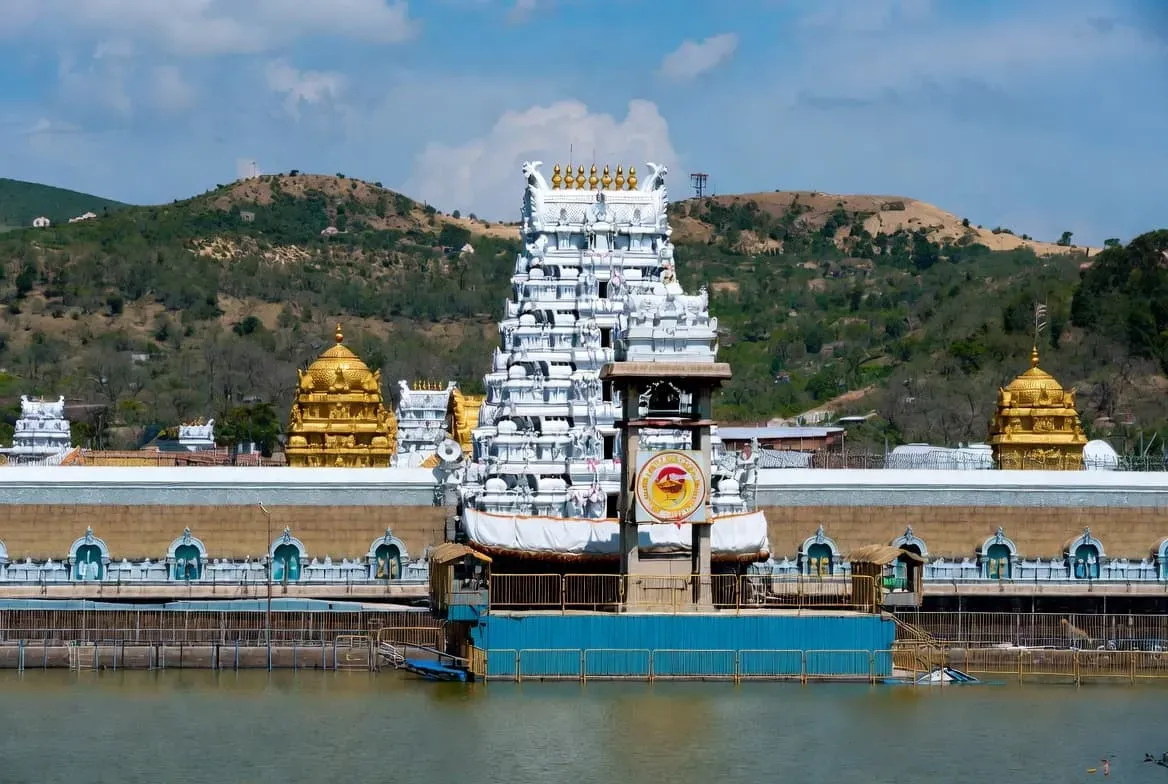
The temple complex at Tirumala is a masterpiece of Bharatiya architecture that has evolved over many centuries of royal patronage and devotional investment. The main sanctum — the Ananda Nilayam — is crowned by a golden vimanam (tower above the sanctum) that gleams brilliantly in the hill light, signalling the divine presence within. The approach to the sanctum passes through a series of beautifully carved mandapas, each adding to the sense of gradual, sacred entry.
The idol of Venkateswara stands approximately two metres tall in a naturally self-manifested form (swayambhu), adorned each day in elaborate silks, jewels, and flower garlands following strict Agamic ritual protocols. The four-armed lord holds a conch and discus, and the expression on the deity's face — serene, compassionate, and slightly smiling — is considered so powerfully moving that many devotees weep involuntarily at their first darshan.
Devotees offer their hair at Tirumala as a gesture of surrender — releasing vanity, releasing the ego, and standing before the Lord as they truly are: bare, humble, and beloved.
Spiritual Significance & Legend
The Lord Who Borrowed Gold
The mythology of Tirupati carries a legend that has resonated with devotees for centuries. According to the Venkatachala Mahatmya, Lord Vishnu descended to the Tirumala hills and, wishing to marry the goddess Padmavathi (born in this age on the plains below), needed wealth for the wedding. He borrowed a vast sum of gold from Kubera, the divine treasurer, promising to repay it with interest until the end of the present age.
It is this divine debt, the legend says, that devotees seek to help repay through their offerings — and the temple's famous hundi (donation box) receives offerings of gold, jewellery, and cash that collectively make the TTD one of the wealthiest religious institutions in the world. Beyond the legend, the offering of one's hair — the most common act of devotion at Tirumala, performed by millions annually — represents a willing sacrifice of personal pride, a gesture of complete surrender to the divine will.
Pilgrimage Guide
Visiting Tirumala
Best Time to Visit
The temple is open year-round. Weekdays are less crowded. Brahmotsavam festival (September/October) is the grandest occasion.
Darshan Tickets
Online booking via the TTD portal is strongly recommended. Special Entry Darshan (SED) and free darshan (Sarva Darshan) are both available.
Nearby
Padmavathi Temple in Tiruchanur (6 km from Tirupati town), Kapila Teertham waterfall, Sri Govindarajaswamy Temple in Tirupati city.
Getting There
Tirupati has its own airport and railway station. Buses run regularly to Tirumala. A foot trek of 11 km via Alipiri is also popular.
Govinda! Govinda!
May Lord Venkateswara bless all seekers who climb the sacred hills with faith in their hearts.