
First Jyotirlinga · Prabhas Patan
Somnath Temple
Destroyed and rebuilt through the ages — Somnath is India's most powerful testament to the faith that cannot be broken.
Overview
Where Sea, River, and Sky Meet the Sacred
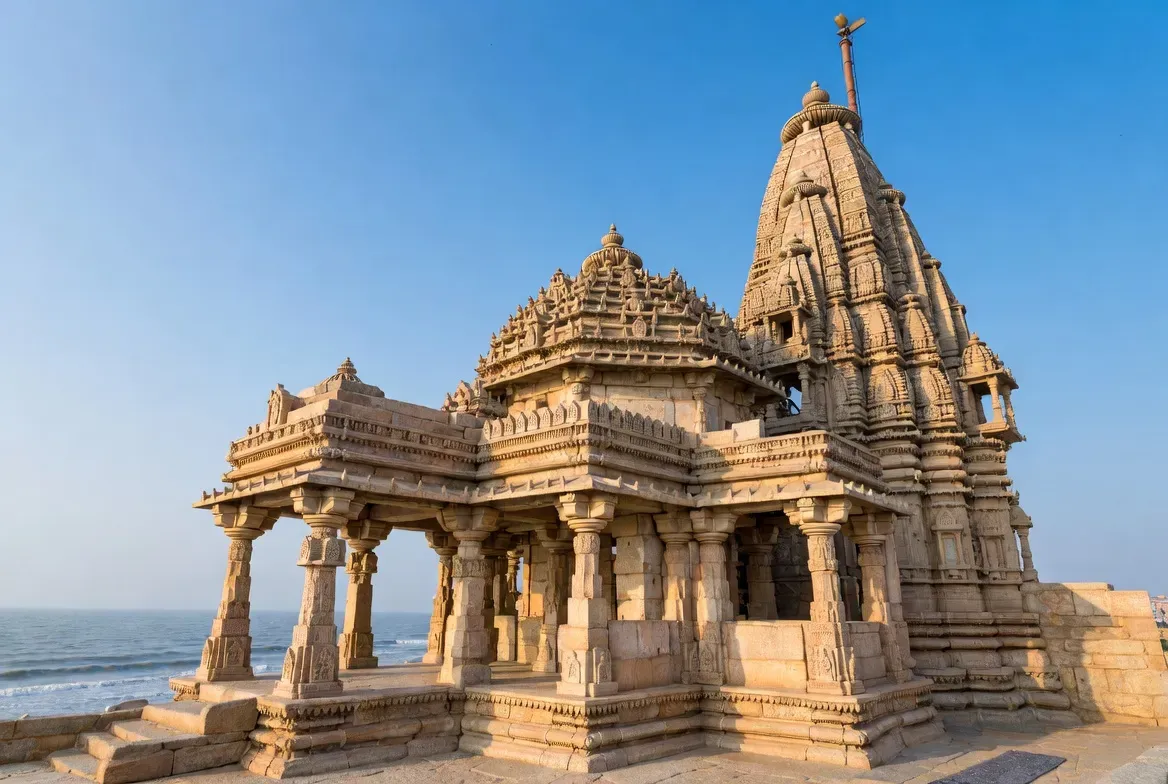
At the southwestern tip of the Saurashtra peninsula in Gujarat, where the waters of the rivers Hiran, Kapila, and the mythical Saraswati converge before flowing into the Arabian Sea, stands the Somnath Temple — counted first among the twelve Jyotirlingas of Shiva and one of the most storied sacred sites in India's long history. The setting itself is extraordinary: the temple rises at the water's edge where the ocean stretches southward without interruption all the way to Antarctica, a geographical fact noted on a pillar within the complex called the Baan Stambh (arrow pillar).
What makes Somnath unique among all Jyotirlingas is not only its antiquity and sanctity but the extraordinary narrative of its survival. Attacked, looted, and demolished multiple times across the centuries, it has been rebuilt with devotion each time, making it not merely a temple but a living symbol of the irreducible nature of faith — a flame that conquest can suppress but never extinguish.
History
Seven Times Built, Seven Times Reborn
Ancient texts describe Somnath as one of the most splendid temples ever built on Indian soil, and accounts from Arab and Central Asian travellers of the medieval period paint a picture of extraordinary magnificence — of a structure so richly appointed with gold and precious stones that it strained the vocabulary of those who attempted to describe it. The temple was famously sacked by Mahmud of Ghazni in 1025 CE, an attack that became one of the most discussed events in medieval Indian history. Yet each time the temple was damaged, the response of the Hindu community was immediate and resolute: it was rebuilt.
The final and present reconstruction of the Somnath Temple was undertaken after Indian independence, at the initiative of Sardar Vallabhbhai Patel and the writer and administrator K.M. Munshi. The restored temple was consecrated in 1951 in the presence of President Rajendra Prasad, and it stands today as one of independent India's most powerful acts of cultural and spiritual reclamation — a statement that the living traditions of the civilisation will not be defined by the moments of their suppression but by the spirit of their renewal.
Architecture
The Kailash Mahameru Prasada Style
The present Somnath Temple was constructed in the Kailash Mahameru Prasada style — a form of Chalukya (Solanki) architecture native to Gujarat — designed by the architect Prabhashankar Sompura. The structure rises in a series of elegant tiers to a shikhara (spire) that is both imposing and graceful, crowned by a traditional amalaka (ribbed disc) and kalasha (finial pot). The entire temple complex faces east-west, with the principal entrance drawing pilgrims through a grand courtyard toward the sanctum.
The Jyotirlinga within the sanctum is set in a silver platform beneath a silver canopy, surrounded by the fragrance of sandalwood paste, camphor, and marigold garlands. The temple stands directly on the shoreline, and the sound of the Arabian Sea — heard clearly from within the complex — adds a quality of elemental grandeur to the act of worship that no interior could replicate.
The Baan Stambh at Somnath bears an inscription noting that between this point and the South Pole, across the entire breadth of the ocean, there is no landmass. It is a statement that places this sacred ground at the very edge of the known world.
Spiritual Significance & Legend
How the Moon God Built the First Temple
The mythology of Somnath begins with Soma — the moon god — who was married to the twenty-seven daughters of Daksha (representing the twenty-seven lunar mansions). Soma gave all his love to only one of them, Rohini, neglecting the others. The aggrieved daughters complained to their father, and Daksha cursed Soma to lose his luminous beauty — and the moon indeed began to wane, threatening all life on earth that depended on moonlight and the lunar cycles governing crops and tides.
Soma sought relief and was directed to worship Shiva at the holy confluence in Prabhas Kshetra. He performed intense penance, and Shiva, moved by this devotion, partially lifted the curse — the moon would wax and wane in alternating cycles, growing full and then diminishing in an eternal rhythm that preserves the celestial balance. In gratitude, Soma built the original Somnath temple in gold. Successive mythological builders — Ravana in silver, Krishna's descendants in stone — are also mentioned in ancient accounts, each adding to the temple's legendary lineage.
Pilgrimage Guide
Visiting Somnath
Best Time to Visit
October to March is ideal. Mahashivaratri and Kartik Purnima are the most significant festival days at this temple.
Temple Timings
Open 6:00 AM to 9:30 PM. A sound and light show at the adjacent Triveni Sangam beach is held every evening after sunset.
Nearby
Bhalka Teerth (where Lord Krishna is said to have departed the earth), Triveni Ghat, and the Prabhas Patan Museum of antiquities.
Getting There
Nearest airport is Diu (65 km) or Rajkot (190 km). Veraval railway station is the closest railhead, just 6 km away.
Jai Somnath
May the Lord of the Moon bless all who stand before him at the edge of the infinite ocean.