
Shakti Pitha · Trikuta Mountains · 5,200 ft
Vaishno Devi Temple
The mother waits in her mountain cave — and millions climb through the night to be in her presence.
Overview
The Mountain Mother of India
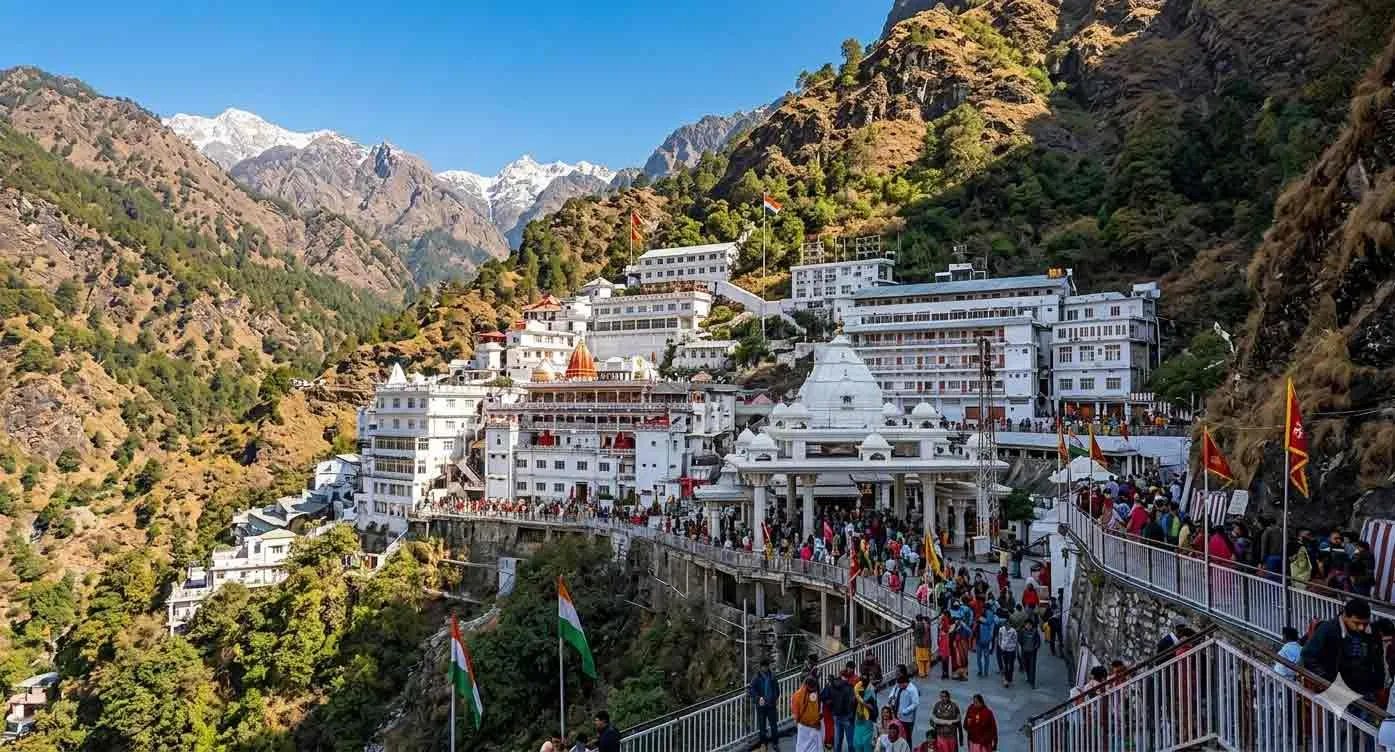
In the forested slopes of the Trikuta Mountains in the Reasi district of Jammu and Kashmir, at an elevation of approximately 5,200 feet above sea level, lies one of the most visited and beloved pilgrimage shrines in all of India. The Vaishno Devi cave temple receives more than eight million pilgrims each year — drawn not by the promise of spectacle but by something far more intimate: the desire to be in the presence of the Divine Mother, to feel held by a grace that is ancient and unconditional.
Unlike most Hindu temples where the deity is represented by a crafted idol, the goddess Vaishno Devi is enshrined in three naturally occurring rock formations called pindis — uncarved, self-formed, self-manifested — representing the three aspects of the divine feminine: Mahakali, Mahalakshmi, and Mahasaraswati. The cave itself, narrow and low-ceilinged, creates an experience of extraordinary closeness with the sacred — an intimacy that pilgrims describe as unlike any idol-based worship, as though the goddess is not represented here but literally present.
History
From Ancient Legend to Modern Pilgrimage
References to a goddess enshrined in the Trikuta range appear in texts and regional traditions dating back many centuries, and the site is mentioned in connection with the Mahabharata period in some accounts. However, it is in the popular devotional tradition — particularly in the oral and literary culture of the Jammu region — that the legend of Vaishno Devi as a specific deity and the cave as her permanent dwelling has crystallised most fully.
The Shri Mata Vaishno Devi Shrine Board, established by the Government of Jammu and Kashmir, has administered the shrine since 1986 and has overseen the systematic development of the pilgrimage route with facilities for the millions who undertake it. The route has been progressively improved with steps, lighting, rest points, and medical facilities, though the trek remains a genuine physical undertaking — and intentionally so, for the effort of the journey is inseparable from the spiritual experience of the destination.
The Sacred Cave
Three Pindis — One Divine Presence
The holy cave of Vaishno Devi is the spiritual heart of the entire pilgrimage. The original cave — now called the Purani Gufa (old cave) — is a natural limestone formation approximately thirty metres long and narrows at certain points to a width that requires pilgrims to wade through a shallow stream in a deeply bowed posture. This act of physical humbling is experienced by many as a ritual of submission — the body enacting what the heart attempts in prayer.
Within the cave, the three pindis emerge naturally from the rock: the central Mahakali pindi is dark, the Mahalakshmi pindi is of a lighter tone, and the Mahasaraswati pindi is white. They are adorned with silver faces (chhatris) and surrounded by flowers, incense, and the soft light of oil lamps. A new cave (Navin Gufa) was constructed adjacent to the original to manage the growing volume of pilgrims, allowing darshan of the pindis through a wider passage while the ancient cave remains available for those who wish to experience the original narrow passage.
On the path to Vaishno Devi, strangers become companions, the young help the elderly, and the chant of "Jai Mata Di" passes from lip to lip across the mountain — turning a personal journey into a communal act of love.
Spiritual Significance & Legend
The Goddess Who Refused to Be Disturbed
The most widely told legend of Vaishno Devi describes the goddess — in the form of a young woman called Vaishnavi — meditating in this cave after a long spiritual journey. A tantric named Bhairavnath, having been impressed by her powers but driven by ego and obsession, pursued her to the cave with the intent of disrupting her meditation. The goddess, in her form as Mahakali, destroyed Bhairavnath at the mouth of the cave — but in her infinite compassion, she granted him a boon: that any pilgrim who saw his shrine (situated a few kilometres beyond the cave) after completing darshan at her cave would receive the full merit of the pilgrimage. The Bhairavnath Temple atop a nearby hill is thus an integral part of the Vaishno Devi yatra, and pilgrims traditionally climb to it after the main darshan.
The legend carries several layers of meaning — the victory of concentrated spiritual power over ego-driven pursuit, the integration of masculine and feminine divine energies in the sacred geography of the mountain, and the characteristic generosity of the goddess who transforms even her adversary into a servant of the pilgrim. These themes are felt intuitively by the millions who undertake this journey year after year, many of them returning again and again throughout their lives as though drawn by something that cannot be adequately explained in any language but that of the heart.
Pilgrimage Guide
Undertaking the Vaishno Devi Yatra
Best Time to Visit
March to July and September to November are ideal. The shrine is open year-round, though winters bring snow and cold on the upper stretches.
The Trek
14–15 km from Katra base camp to the cave. Ponies, palanquins, and battery-operated vehicles are available on parts of the route. Helicopters operate from Katra and Sanjichhat.
Registration
All pilgrims must register with the Shrine Board at Katra — online in advance or at the registration counters. A yatra slip is mandatory for entry.
Getting There
Katra is the base town, well connected by road and rail from Jammu (50 km). Jammu has an airport with flights from major Indian cities.
Jai Mata Di
May the Divine Mother of the Trikuta mountains embrace every pilgrim who climbs toward her with love, longing, and faith.