
Char Dham · Rath Yatra · Odisha
Jagannath Temple, Puri
The Lord of the Universe — with eyes like oceans and a form that defies all convention — invites the whole world to his chariot.
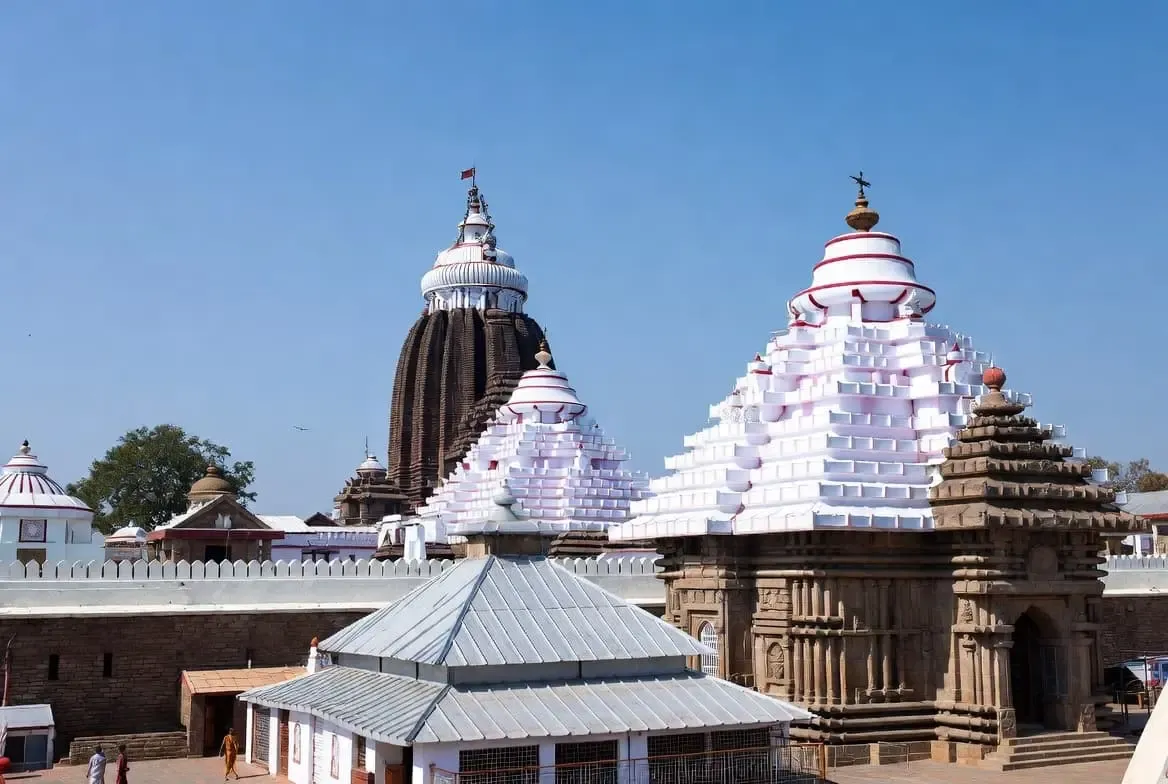
An artistic representation of the Jagannath Temple in Puri, Odisha, showcasing its iconic architecture and the spiritual aura that surrounds it.
Overview
The Lord Who Belongs to Everyone
On the eastern coast of India, where the Bay of Bengal stretches to the horizon, the city of Puri is dominated by the great spire of the Jagannath Temple — a tower that rises sixty-five metres above the coastal plain and has served as a landmark for sailors navigating the Bay for close to a thousand years. The temple is one of the four sacred dhams of Hindu pilgrimage, and Lord Jagannath — the Lord of the Universe — is a deity whose form and tradition are unlike any other in the Hindu pantheon.
Jagannath is understood to be a manifestation of Lord Vishnu, and more specifically of Krishna, but his iconography — with large, circular, unblinking eyes, a limbless torso carved from neem wood, and a form that is renewed every twelve to nineteen years in a ceremony called the Nabakalebara — connects this tradition to some of the oldest layers of Indian religious consciousness, predating classical Sanskrit culture and reaching into the tribal and folk spiritual heritage of Odisha.
History
The Eastern Ganga Dynasty and After
The current stone temple complex was largely constructed in the twelfth century under Anantavarman Chodaganga Deva of the Eastern Ganga dynasty — one of the most powerful rulers of medieval Odisha. The construction of the main temple was completed by his successor, Ananga Bhima Deva III, in 1197 CE. The complex as it exists today reflects contributions from numerous subsequent dynasties, particularly the Gajapati kings of Odisha, who held the title of Dasa (servant) of Jagannath and regarded themselves as stewards of the Lord's temple rather than its masters — a remarkable theological position that placed even the king in a subordinate spiritual role.
The temple has been an enduring centre of Vaishnava devotionalism and was associated with the great saint-philosopher Ramanuja in the twelfth century and with Sri Chaitanya Mahaprabhu in the sixteenth century, both of whom spent significant time in Puri and whose teachings were shaped by their proximity to the Jagannath tradition.
Architecture
The Kalinga Style in Its Fullest Splendour
The Jagannath Temple is an outstanding example of the Kalinga school of temple architecture, characterised by its curvilinear tower (deula), elaborate decorative programme, and four interconnected structures arranged on the east-west axis. The main deula (sanctum tower) rises sixty-five metres and is topped with the wheel of Vishnu and a flag that is changed every single day. Even today, a priest climbs the sheer face of the tower daily — without safety equipment, as tradition demands — to change the flag, a practice maintained without interruption for centuries.
The four main structures of the complex — the Vimana (sanctum), the Jagamohana (porch), the Natamandira (dance/music hall), and the Bhogamandapa (offering hall) — are arranged in a line and create a processional sequence from the outer world toward the inner sanctum that is both architecturally and spiritually deliberate. The kitchen within the temple complex is one of the largest in the world, capable of feeding tens of thousands of pilgrims daily from its fifty-six varieties of daily offering (Chappan Bhog).
The Mahaprasad of Jagannath — the sacred food offered to the Lord — is considered so holy that it dissolves all distinctions of caste and status. At the Lord's table, all are fed as equals.
Spiritual Significance & Legend
The Idol That Was Never Finished
The origin legend of the Jagannath idol is one of the most poetic in all of Hindu tradition. King Indradyumna of Malwa received a divine instruction in a dream to seek a sacred log of neem wood that would wash ashore at a specific beach. The log was found, and the divine craftsman Vishwakarma himself came in disguise as an old carpenter to carve the idol — on the condition that he not be disturbed until the work was complete.
Unable to contain their impatience, the king's attendants opened the workshop door before the work was finished. The old craftsman vanished, leaving behind idols that had faces and eyes but no fully formed limbs. A divine voice then instructed the king to install these incomplete forms as the presiding deities — for the Lord of the Universe, the voice declared, chooses to manifest in the form he has chosen, not in the form that human expectation would impose. It is this theological embrace of incompleteness, of the sacred that exceeds human comprehension, that gives the Jagannath form its extraordinary and timeless spiritual power.
Pilgrimage Guide
Visiting Jagannath Puri
Best Time to Visit
October to March is pleasant. The Rath Yatra (June/July, Ashadha Shukla Dwitiya) is the grandest event, drawing millions of devotees.
Entry Note
Non-Hindus are not permitted inside the temple. The Raghunandan Library opposite provides a viewing platform for all visitors.
Nearby
Gundicha Temple (the chariot's destination during Rath Yatra), Chilika Lake (50 km), Konark Sun Temple (35 km), and Puri beach.
Getting There
Puri has its own railway station with direct trains from major cities. The nearest airport is Bhubaneswar (60 km).
Jai Jagannath
May the Lord of the Universe — in his boundless, unconventional form — bless all who approach him with open hearts.