
UNESCO World Heritage · Chola Empire · 1010 CE
Brihadeeswarar Temple
A thousand years of unbroken sacred presence — the masterwork of the Chola empire, and one of the greatest temples ever built on earth.
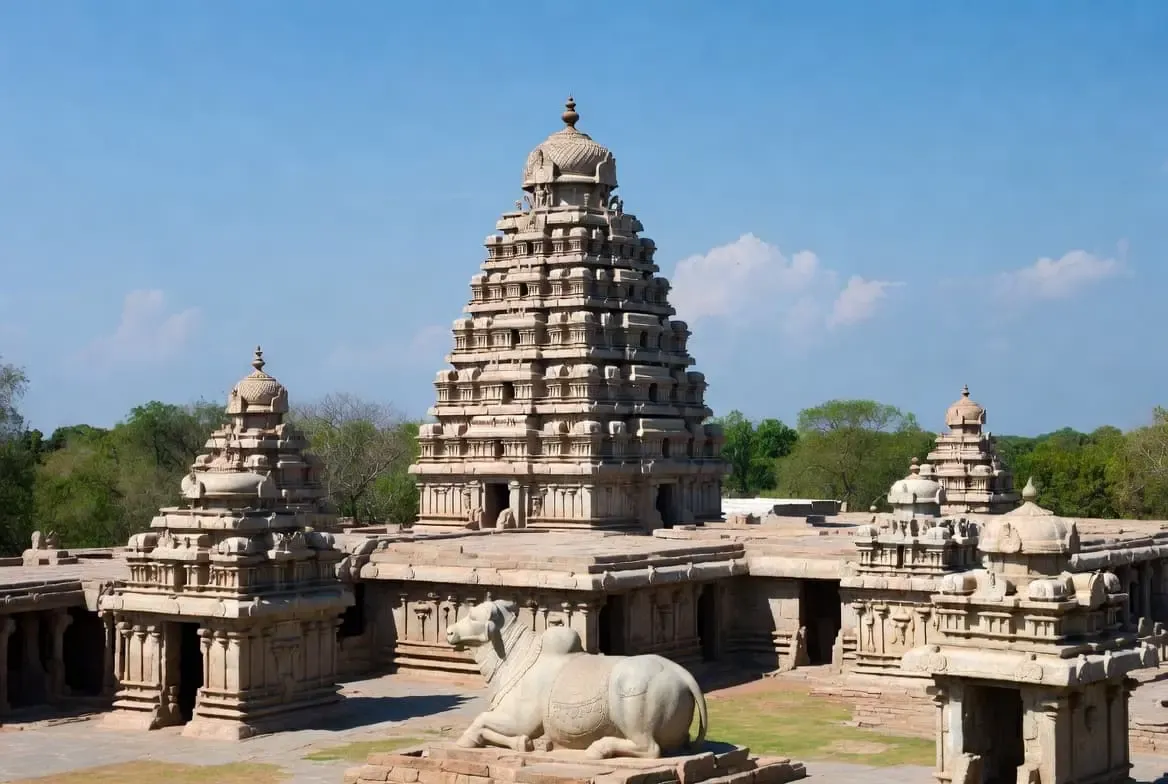
Overview
The Great Temple of the South
Among all the temples of South India — a region of extraordinary temple-building traditions spanning two millennia — the Brihadeeswarar Temple in Thanjavur (also called the Big Temple or Peruvudaiyar Kovil) stands apart in a category of its own. Built over a thousand years ago and consecrated in 1010 CE, it is a structure of such ambition, such mathematical precision, and such breathtaking architectural confidence that it continues to astonish engineers, art historians, and pilgrims alike.
Recognised as a UNESCO World Heritage Site and listed as one of the Great Living Chola Temples — living because worship has continued here without interruption since its consecration — the Brihadeeswarar Temple represents the zenith of the Chola empire's extraordinary creative achievement. It is dedicated to Lord Shiva in his aspect as Brihadeeswarar (the Great Lord) and stands as a cosmological statement in granite: a human-built mountain, a Meru in stone, at the heart of the Chola heartland.
History
Raja Raja Chola's Supreme Offering
The Brihadeeswarar Temple was built by Raja Raja Chola I — one of the greatest rulers in Indian history — and work on it began around 1003 CE and was completed in 1010 CE, an achievement of remarkable speed for a structure of such complexity and scale. Raja Raja was an extraordinarily capable military commander and administrator who had extended the Chola empire across much of South India and into Southeast Asia. The temple was his personal offering to his patron deity, conceived on a scale commensurate with the grandeur of the empire over which he presided.
The temple's inscriptions — engraved in Tamil and Grantha script on its walls and still largely intact — are among the most valuable historical documents of the Chola period, recording in meticulous detail the temple's assets, the villages assigned to support it, the names of dancers and musicians in its service, and the identities of the craftspeople who built it. These inscriptions give the Brihadeeswarar a historical specificity unusual among ancient Indian monuments.
Architecture
A Vimana That Casts No Shadow
The central vimana (tower above the sanctum) of the Brihadeeswarar Temple rises to a height of approximately sixty-six metres, making it one of the tallest temple towers constructed in India at the time of its building. The tower is built of granite in tapering tiers, each decorated with pilasters, sculptures, and architectural ornament, culminating in an octagonal dome (griva) and a large capstone (stupi) estimated to weigh around eighty tonnes — a single piece of granite that was raised to the summit using an inclined ramp said to have stretched for several kilometres.
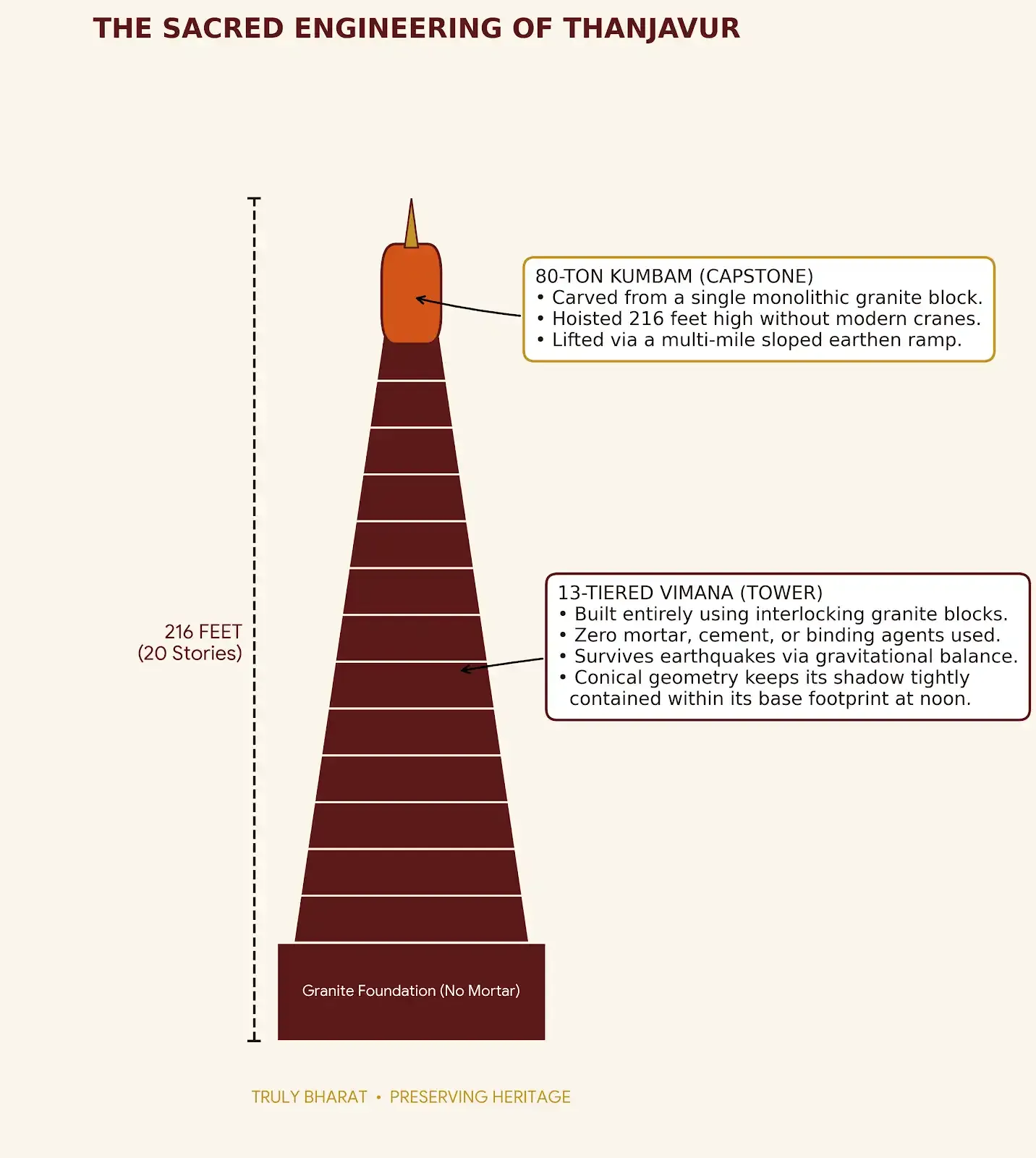
Visual breakdown of the Chola architectural framework and interlocking structural design.
One of the most celebrated features of the temple is architectural and astronomical in nature: at noon, the shadow of the great vimana does not fall on the ground around the temple — the tower is designed so that at the moment of solar zenith, its shadow falls upon itself. This feat of deliberate astronomical engineering, achieved a thousand years ago without modern instruments, speaks to the advanced scientific knowledge embedded in Chola temple construction. The sixteen-tonne monolithic Nandi (sacred bull) that faces the main shrine from the second enclosure — carved from a single stone — is one of the largest Nandi sculptures in India.
The Brihadeeswarar does not merely honour Shiva — it attempts to be Shiva's mountain, Meru, built in stone in the southern plains. Its builders were not simply craftsmen but cosmologists working in granite.
Spiritual Significance & Art
Chola Frescoes and the Dance of the Cosmos
Within the corridors of the Brihadeeswarar Temple, partially hidden beneath later layers of Nayaka-period plasterwork, are some of the oldest surviving Chola frescoes — paintings in natural pigments that depict Shiva in various manifestations, the Chola royal family, and celestial scenes from Hindu mythology. These were rediscovered in the twentieth century when the outer plaster was carefully removed, revealing a treasury of medieval South Indian painting that had been preserved by its own concealment.
The temple's outer walls and corridors are also adorned with 108 karanas — the classical dance poses described in the Natya Shastra of Bharata Muni — carved in bas-relief and representing one of the most complete surviving visual encyclopaedias of classical Indian dance. These carvings suggest that the Brihadeeswarar was not only a place of worship but a living academy of the sacred arts, a centre of music, dance, and learning that served as a cultural heart of the Chola world.
Pilgrimage Guide
Visiting Brihadeeswarar
Best Time to Visit
October to March. The Shivaratri festival and the anniversary of the temple's consecration (Karthigai Deepam) are particularly significant.
Temple Timings
Open 6:00 AM to 12:30 PM and 4:00 PM to 8:30 PM. The ASI museum within the complex is also worth visiting separately.
Nearby
Thanjavur Royal Palace and Saraswati Mahal Library (1 km), Schwartz Church, and the Gangaikonda Cholapuram temple (70 km).
Getting There
Thanjavur has its own railway station with good connectivity. The temple is in the city centre, easily reached by auto-rickshaw or taxi.
Thillai Natarajar Thiruvadigal Sharanam
May the eternal artistry of the Chola builders — and the divine grace of Brihadeeswarar — inspire all who stand in this sacred presence.