
Shakti Shrine · Ancient Madurai
Meenakshi Amman Temple
A city within a city — where fourteen towers of colour and myth rise above the oldest continuously inhabited city in India.
Overview
A Universe in Stone and Colour
Madurai — one of the oldest continuously inhabited cities in the world — has been a centre of Tamil culture, learning, and devotion for well over two millennia. At its heart, the Meenakshi Amman Temple does not merely stand within the city; in many ways, it is the city's reason for being. The temple complex covers approximately 6.5 hectares and contains within it halls, tanks, shrines, and galleries that together constitute a self-contained sacred universe.
The temple honours two presiding deities: Goddess Meenakshi — an incarnation of Parvati, the divine feminine — and her consort Lord Sundareswarar, a manifestation of Shiva. Their divine marriage is not treated as a historical event but as a living cosmic reality that is ritually re-enacted each day, each month, and most grandly each year during the Meenakshi Tirukalyanam festival, when the celestial wedding of the goddess and her lord draws hundreds of thousands of witnesses.
History
The Pandya Legacy and Its Heirs
The earliest temple at this site is attributed to the ancient Pandya kings, the dynasty that ruled from Madurai and regarded the goddess Meenakshi as their royal protector. Inscriptional evidence and literary references place a significant temple complex here well before the common era, though the structure was damaged and altered through various periods of history.
The most decisive expansion of the temple as it appears today was undertaken by the Nayaka rulers of the sixteenth and seventeenth centuries — particularly Tirumala Nayak, who commissioned the magnificent Hall of a Thousand Pillars and oversaw major additions to the gopuram system. It is largely to these Nayaka-period builders that the temple owes the overwhelming architectural scale that makes it one of the supreme achievements of Sanatana temple construction.
Architecture
Fourteen Towers of the Sacred Imagination
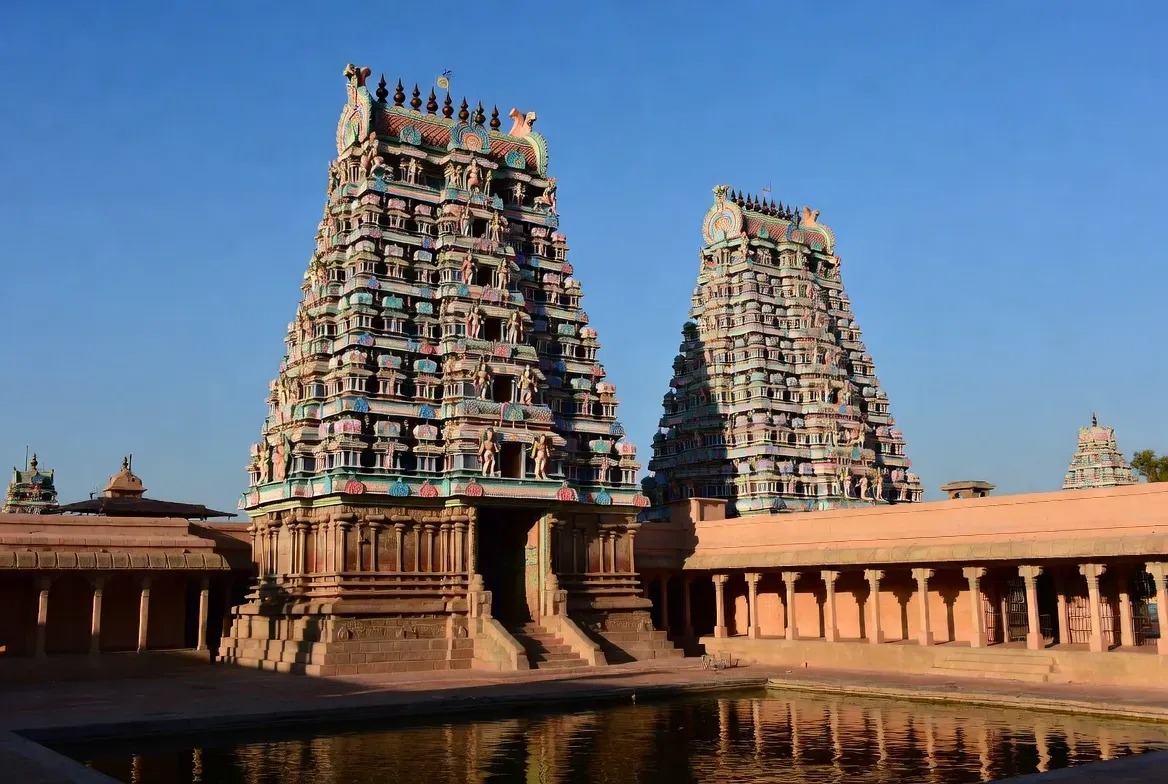
The Meenakshi Amman Temple is enclosed within four concentric rectangular walls, each punctuated by towering gopurams — the magnificent gateway towers unique to South Indian temple architecture. Of the fourteen gopurams, four are the principal gateways to the inner sanctum. The tallest of these, the southern tower, rises to approximately fifty-two metres and is encrusted with over thirty-three thousand individual stucco sculptures, painted in vivid colours and depicting the full range of Hindu mythology from Puranic scenes to the legends specific to Madurai.
Within the innermost enclosure lies the Potramarai Kulam — the golden lotus tank — around which devotees circumambulate in quiet meditation. The Ayirakkal Mandapam (Hall of a Thousand Pillars, which actually contains 985) features intricately carved monolithic columns, each different from the next, demonstrating the extraordinary skill of the craftspeople of the Nayaka period. The musical pillars in this hall — columns that emit distinct musical notes when tapped — remain one of the great unexplained architectural achievements of ancient India.
In Madurai, the divine feminine does not wait to be approached. She rules — as queen, as warrior, as mother — and Shiva himself came to this city to be at her side.
Spiritual Significance & Legend
The Queen Who Was Born to Rule
The legend of Meenakshi begins with the Pandya king Malayadhwaja, who performed great penances seeking a child. A miraculous three-year-old girl emerged from the sacrificial fire — dark-skinned, with eyes shaped like fish, and bearing a third breast. The celestial voice declared that the third breast would disappear when she met her future husband. The king raised her as his heir, and she grew into a magnificent warrior queen who conquered all the worlds.
When Meenakshi arrived at Mount Kailash to conquer Shiva, their eyes met — and her third breast vanished. She realised she had found her divine counterpart. Shiva took the form of Sundareswarar and came to Madurai, where the two were wed in a celestial ceremony witnessed by all the gods. This mythology places the feminine deity in the primary position of power and glory — she is the one who rules the city, who wages the battles, who presides at the main sanctum — while Shiva comes to her domain as her beloved. It is a rare and remarkable theological arrangement that gives Madurai its distinctive spiritual character.
Pilgrimage Guide
Visiting Meenakshi Amman
Best Time to Visit
October to March is pleasant. The Chitirai festival (April/May) and Meenakshi Tirukalyanam are the grandest annual events.
Temple Timings
Open 5:00 AM to 12:30 PM and 4:00 PM to 9:30 PM. The evening procession of the deities is a particularly moving experience.
Nearby
Thiruparankundram Murugan Temple (8 km), Alagar Kovil, Gandhi Memorial Museum, and the vibrant textile markets of Madurai.
Getting There
Madurai has a well-connected airport and railway station. The temple is in the heart of the old city and easily reached by auto or taxi.
Meenakshi Sharanam
May the fish-eyed queen of Madurai bless all who enter her magnificent kingdom with wonder and devotion.