
The Supreme Abode · Srirangam Island
Sri Ranganathaswamy Temple
The foremost of the 108 Divya Desams, spreading across 156 acres to form the largest functioning Hindu temple complex in the world.
Overview
A Celestial City on Earth
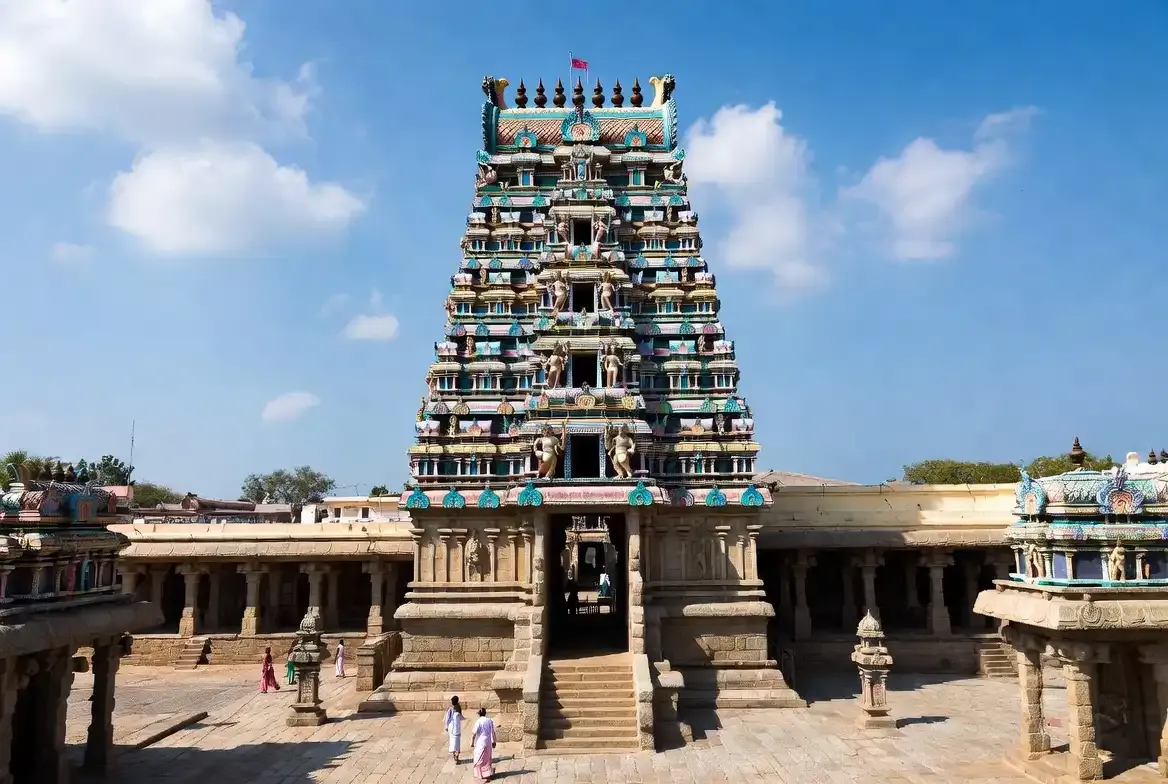
Resting upon an island embraced by the Kaveri and Kollidam rivers, the Sri Ranganathaswamy Temple is not merely a place of worship, but a sprawling, living city of devotion. Covering a staggering 156 acres, it holds the distinction of being the largest active temple complex globally. Unlike conventional temples that sit within a town, Srirangam is a town enveloped entirely by the temple. The sacred and the secular coexist seamlessly here, with the outer enclosures housing streets, homes, and bustling markets that eventually give way to the profound silence of the inner sanctums.
The presiding deity is Lord Ranganatha, a majestic, reclining manifestation of Lord Vishnu resting upon the coils of Adishesha, the cosmic serpent. It is considered the first and most vital among the 108 Divya Desams (sacred abodes of Vishnu sung by the Alvar saints). For millions of Vaishnavas, stepping into Srirangam is equivalent to stepping into Vaikuntha (the celestial realm of Vishnu) itself.
History
A Canvas of Empires
The architectural evolution of Srirangam spans over a millennium, serving as a cumulative canvas for Southern India’s greatest empires. The early foundations are credited to the Cholas, but subsequent layers of grandeur were meticulously added by the Pandyas, Hoysalas, and Vijayanagara kings. Each dynasty sought to outdo the last in expressing their devotion, resulting in an unparalleled concentration of Mandapams (halls), intricately carved pillars, and massive gateways.
However, the temple's history is also marked by profound resilience. During the tumultuous invasions of the 14th century, the temple faced severe plundering. Legend states that devotees went to extraordinary lengths to protect the main idol, building decoy walls and smuggling the processional deity across Southern India for decades before it was triumphantly restored. Srirangam today stands as a monument not just to royal patronage, but to the indestructible faith of the common devotee.
Architecture
The Seven Concentric Realms
The genius of Srirangam's layout lies in its Sapta Prakarams—seven massive, concentric rectangular enclosures. These thick stone walls represent the seven spiritual centres (chakras) of the human body or the seven cosmic elements. As a pilgrim moves from the bustling outermost gates toward the dimly lit, gold-roofed inner sanctum, the physical journey mirrors an inward spiritual progression from the material world to the supreme soul.
Piercing these walls are 21 magnificent gopurams. The most breathtaking of these is the towering Rajagopuram at the southern entrance. Completed in 1987, it rises to a staggering height of 73 meters (239 feet), making it the tallest temple tower in Asia. Within the enclosures, architectural marvels abound, including the legendary Hall of a Thousand Pillars (carved from granite in the Vijayanagara style) and the Sesharayar Mandapam, famous for its life-sized monolithic sculptures of rearing horses subduing mythical beasts.
Here, the river Kaveri serves as the garland, and the seven monumental walls serve as the fortress for the Supreme Lord who rests in cosmic slumber, maintaining the equilibrium of the universe.
Spiritual Significance & Legend
The Idol That Refused to Move
The origins of Srirangam are steeped in the epic Ramayana. According to the Sriranga Mahatmyam, the idol of Lord Ranganatha was originally worshipped by Lord Brahma in the celestial realms, before being passed down through the solar dynasty to Lord Rama. After his victory in Lanka, Rama gifted this supreme idol to the virtuous demon-king Vibhishana as a token of love, with a strict condition: the idol must not be placed on the ground during his journey south.
While passing the lush island formed by the Kaveri river, Vibhishana stopped to perform his daily rituals and placed the idol on the earth. When he attempted to lift it again, it had become rooted to the island. Though Lord Ranganatha refused to move further, he granted Vibhishana a merciful boon: the deity would forever recline facing south, casting his protective gaze over Vibhishana's kingdom in Lanka. Thus, unlike most Hindu deities that face east, Lord Ranganatha of Srirangam rests facing the southern horizon.
Pilgrimage Guide
Visiting Srirangam
Best Time to Visit
November to February is ideal. The 21-day Vaikunta Ekadasi festival (December/January) is spectacular, featuring the opening of the 'Paramapada Vasal' (Gateway to Heaven).
Temple Timings
6:00 AM to 9:00 PM. Note that darshan is paused periodically throughout the day for rituals and offerings (Pooja/Naivedyam).
Nearby
The Jambukeswarar Temple at Thiruvanaikaval (just 2 km away) and the iconic Rockfort Temple dominating the Trichy skyline.
Getting There
Tiruchirappalli (Trichy) is a major hub with an international airport and railway junction. Srirangam has its own local railway station and is heavily serviced by city buses and taxis.
Ranga Ranga
May the resting Lord of Srirangam grant profound peace to all who walk through His seven sacred gates.