
Jyotirlinga · Varanasi
Kashi Vishwanath Temple
The Lord of the Universe dwells on the banks of the Ganga — in a city older than time itself.
Overview
The Eternal City's Eternal Shrine
Among all the sacred sites of Hinduism, few carry the weight of Varanasi — the city that Hindu tradition regards as the earthly residence of Lord Shiva himself, a place so ancient that its origins dissolve into mythology. And at the very heart of this city of ghats and temples and hymns, the Kashi Vishwanath Temple stands as the supreme jewel — the dwelling place of Vishwanath, the Lord of All Worlds.
The temple enshrines one of the twelve Jyotirlingas — the sacred manifestations of Shiva as columns of infinite, self-luminous light — that are scattered across the Indian subcontinent and considered the most powerful forms of Shiva worship. To make a pilgrimage to all twelve is a profound aspiration for devout Hindus, but Kashi Vishwanath occupies a special place even among these, for it is set within a city that carries its own unique spiritual promise: liberation for all who die within its sacred precincts.
History
Built, Broken, and Reborn
The history of the Kashi Vishwanath Temple is one of devotion tested by destruction and renewed by faith. Ancient texts including the Skanda Purana and the Kashi Khanda speak of a temple at this site from time immemorial, and scholarly records trace formal temple structures here back over two thousand years. Through the medieval period, the temple was destroyed by various rulers and rebuilt multiple times by devoted kings and queens who refused to let the flame of faith be extinguished.
The present temple was constructed in 1780 by the great Maratha queen Ahilyabai Holkar of Indore — a ruler of deep personal piety who funded the restoration of temples across the subcontinent. A few decades later, Maharaja Ranjit Singh of the Sikh empire donated approximately one tonne of gold to gild the temple's shikhara, giving it the gleaming golden spire that crowns the skyline of the old city to this day. A major corridor and complex around the temple was inaugurated in 2021, opening up a sweeping view of the Ganga from the temple precinct for the first time in centuries.
Architecture
A Golden Spire Above the Ganga
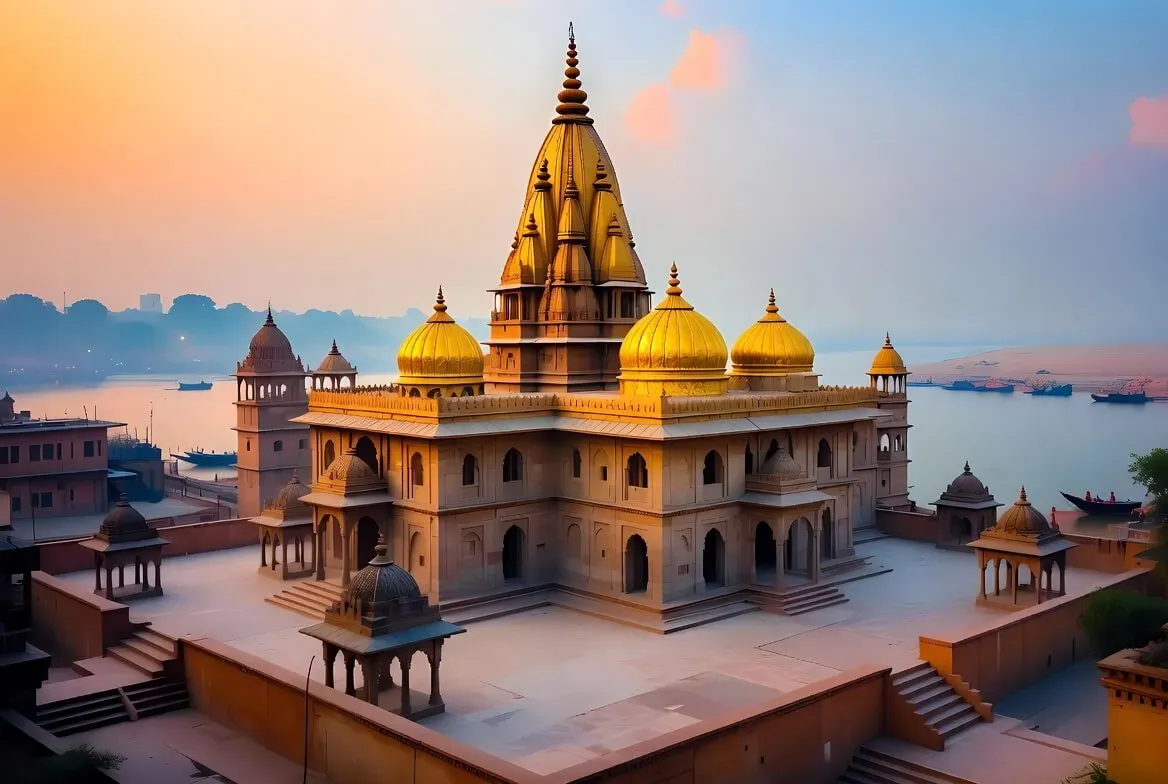
The Kashi Vishwanath Temple follows the Nagara style of north Indian temple architecture, characterised by a curvilinear tower (shikhara) that rises in tiers to a rounded crown. The temple complex has three principal parts: the main sanctum housing the Shiva linga, a mandapa (assembly hall) for worship and prayer, and the sacred Gyan Vapi well just to the north, whose waters are believed to hold a fragment of the Jyotirlinga itself.
The central shikhara is plated in gold — over eight hundred kilograms of it — and blazes brilliantly in the sunlight visible from across the river. The Jyotirlinga in the sanctum is a naturally occurring dark stone column housed in a silver altar and adorned with garlands, rudraksha beads, and sacred ash. The atmosphere inside the inner sanctum, narrow and dim and fragrant with incense and marigold, creates an intensity of sacred experience that pilgrims describe as unlike any other place on earth.
Kashi is not merely a city. It is the palm of Shiva's hand — a place that stands outside the ordinary rhythm of the cosmos, held in grace through every age and every dissolution.
Spiritual Significance & Legend
The City of Liberation
The Kashi Khanda section of the Skanda Purana describes Varanasi as Anandavana — the forest of bliss — and states that Shiva personally bestows liberation upon those who die within its boundaries by whispering the Taraka mantra (the mantra of crossing over) into their ear at the moment of death. This extraordinary promise has drawn seekers and sages to Varanasi for thousands of years, many of them spending their final years in the city in the hope of this divine benediction.
Ancient texts also describe Kashi as existing outside the ordinary structure of the cosmos — a place that remains intact even through the great cosmic dissolutions that periodically absorb the rest of creation. Shiva is said to hold the city in the palm of his hand during these vast intervals, preserving it as a sanctuary of consciousness at the edge of the uncreated. This theological status gives Varanasi a uniqueness that no other city in Hinduism shares.
Pilgrimage Guide
Visiting Kashi Vishwanath
Best Time to Visit
October to March offers the most comfortable climate. The Mahashivaratri festival (February/March) draws the largest gatherings.
Temple Timings
Open from 3:00 AM to 11:00 PM daily. Seven aartis are performed throughout the day — the Mangala aarti at dawn is especially sacred.
Nearby
Dashashwamedh Ghat for the evening Ganga Aarti, Annapurna Temple, Sankat Mochan Hanuman Temple, and Sarnath (8 km away).
Dress & Entry
Modest dress required. Mobile phones and cameras are not permitted inside the temple. Security checks are thorough.
Har Har Mahadev
May Lord Vishwanath bless all who seek him in the eternal city of Kashi.