
Char Dham · Panch Badri · 3,133 metres
Badrinath Temple
In the silence between Himalayan peaks, Vishnu sits in eternal meditation — and Bharat climbs to be near him.
Overview
The Northernmost of the Holy Dhams
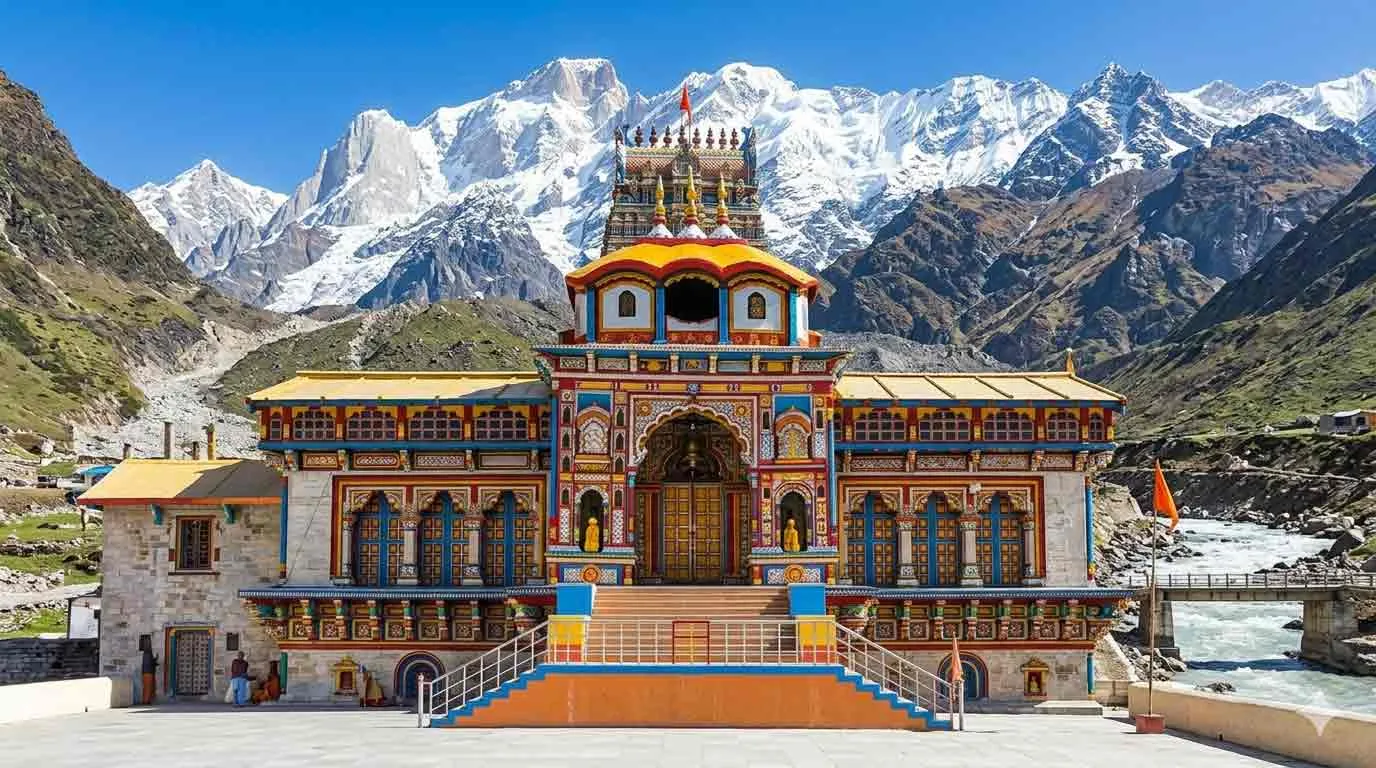
Cradled between the towering Nar and Narayan mountain peaks in the Garhwal Himalayas of Uttarakhand, at an altitude of 3,133 metres above sea level, the Badrinath Temple is the northernmost of the four sacred Dhams and one of the most revered pilgrimage destinations in all of Hinduism. The Alaknanda river — one of the principal tributaries that form the holy Ganga — flows swiftly and icily past the temple complex, fed by glaciers from the surrounding ranges, its waters holding a clarity and chill that is itself experienced as a form of sacred encounter.
The temple enshrines Lord Vishnu in his form as Badrinarayan — the Lord of the Badri tree — seated in yogic meditation (padmasana) in a posture of deep, self-absorbed contemplation. This form of Vishnu as meditating sage, rather than as dynamic cosmic ruler or loving protector, carries a particular theological significance: it suggests that even the preserver of the cosmos withdraws periodically into the stillness of pure awareness, and that the highest act of devotion is to join him there in one's own inner quiet.
History
Shankaracharya's Great Revival
Badrinath appears in some of the most ancient sacred texts of Bharat, including the Mahabharata and the Vishnu Purana, which describe this valley — then called Badrikashrama — as the place where the divine sages Nara and Narayana (avatars of Vishnu) performed eternal austerities for the benefit of all beings. The valley was thus established in sacred consciousness as a site of supreme tapas (spiritual austerity) long before any physical temple was constructed.
The temple in its current organised form is largely attributed to Adi Shankaracharya, the philosopher-saint of the eighth century who visited Badrinath during his pilgrimage across India and found a black stone image of Vishnu submerged in the Narad Kund — a natural pool beside the Alaknanda. He retrieved the image, installed it in a cave temple, and established the Char Dham pilgrimage circuit that has been one of Hinduism's great unifying pilgrimages ever since. He also appointed a Nambudiri brahmin from Kerala as the chief priest (Rawal) of Badrinath — a tradition that continues to this day, with the head priest of this northernmost Himalayan shrine always coming from the southernmost tip of the subcontinent, as Shankaracharya intended.
Architecture
A Colourful Façade in a Monochrome Landscape
The Badrinath Temple presents a striking visual contrast to its surroundings. Its façade — painted in vivid tones of gold, white, and red, with a distinctive arched entrance gateway — blazes brilliantly against the grey granite of the surrounding mountains and the brilliant blue of the Himalayan sky. The building style reflects influences from both the traditional Garhwali architectural vocabulary and later additions from various periods of royal patronage, including the kings of Garhwal who were devoted supporters of the shrine.
The main idol of Badrinarayan — a one-metre-tall image carved from a single block of black shaligram stone — depicts Vishnu seated in cross-legged meditation, adorned with gold ornaments and colourful garments that are changed according to the season and occasion. The idol is considered svayambhu (self-manifested) — not created by human hands but discovered already formed within the sacred stone. The sanctum is divided into fifteen distinct areas of worship, each housing a different deity from the Vaishnava pantheon, making Badrinath a comprehensive cosmological space rather than a single-deity shrine.
The Tapt Kund — the natural hot spring beside the icy Alaknanda — is one of the Himalayas' most poetic paradoxes: boiling water emerging from frozen ground, warmth in the heart of cold. Pilgrims bathe here before darshan, warmed by the earth at the feet of Vishnu.
Spiritual Significance & Legend
Vishnu's Voluntary Hardship
The most beloved legend of Badrinath describes a time when the sage Narada visited the valley and found Lord Vishnu performing intense penance under the harsh conditions of the Himalayan winter. Narada, puzzled, asked why Vishnu — who is said to rest in eternal ease on the cosmic serpent Ananta — would subject himself to such austerity. Vishnu replied that this place held such powerful spiritual energy that he could not resist practising tapas here himself. It is this self-chosen discipline of the Lord that the name Badrinath commemorates — the presiding deity of a place that even Vishnu found irresistible for deep meditation.
Another cherished tradition holds that Parvati, seeing how intensely cold the winters were at Badrinath, took the form of the Badri (Indian jujube) tree to shelter Vishnu from the snow while he meditated — and it is for this act of selfless protection by the goddess that the place and the deity are named. These intertwined legends give Badrinath a quality of divine reciprocity — the goddess shelters the god, the god meditates for the world, and the world climbs to be present with them both.
Pilgrimage Guide
Visiting Badrinath
Open Season
May to November. The temple opens on Akshaya Tritiya and closes on Vijaya Dashami or Kartik Ekadashi. Exact dates are declared annually by the temple committee.
Tapt Kund
Bathing in the Tapt Kund natural hot spring before darshan is a sacred tradition. The spring maintains a year-round temperature of around 45°C despite the surrounding cold.
Nearby
Mana village (3 km — the last village before the China border), Vasudhara Falls, Satopanth Lake, and the Bheem Pul natural rock bridge.
Getting There
Nearest railhead: Rishikesh (297 km). Road journey via Devprayag, Rudraprayag, Karnaprayag, and Joshimath. Helicopter services operate from Dehradun and Haridwar.
Jai Badri Vishal
May Lord Badrinarayan — who chose these frozen heights for his own meditation — bless all seekers with the stillness they are truly seeking.