
Char Dham · Panch Kedar · 3,583 metres
Kedarnath Temple
High in the Himalayas where the snow never fully retreats — Shiva waits for those willing to climb.
Overview
The Highest of the Holy
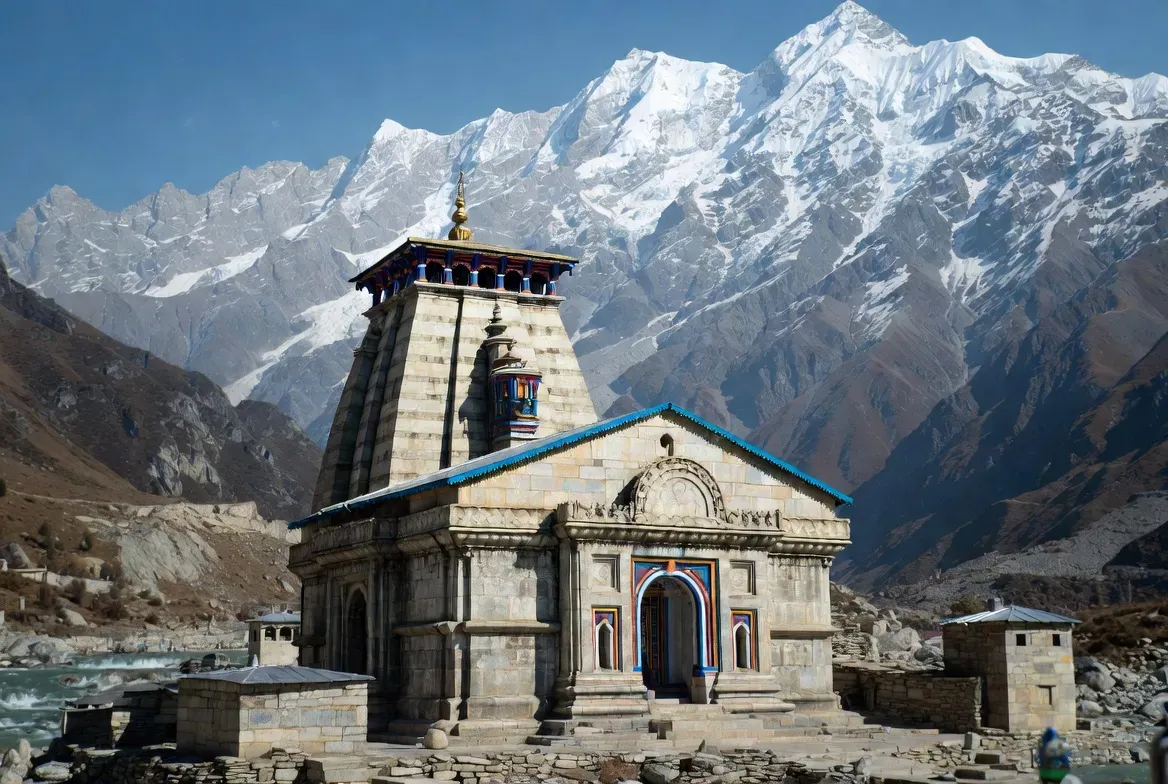
At an elevation of 3,583 metres in the Garhwal Himalayas of Uttarakhand, surrounded on all sides by snow-crowned peaks and cut through by the white noise of the Mandakini river, the Kedarnath Temple occupies one of the most dramatically sacred positions of any shrine on earth. It is one of the four sacred dhams of the Char Dham Yatra, one of the twelve Jyotirlingas, and first among the five Panch Kedar shrines scattered across the Garhwal range — making it a site of exceptional sanctity by multiple measures.
The temple is accessible only on foot — a trek of approximately sixteen kilometres from Gaurikund, the last motorable point — or by helicopter. It is open only during the summer months, from Akshaya Tritiya (April/May) to Kartik Purnima (November), after which the valley is sealed under metres of snow and the deity is ceremonially moved to the Omkareshwar Temple in Ukhimath, forty kilometres away, where worship continues through the winter.
History
From the Pandavas to Shankaracharya
Hindu tradition ascribes the original establishment of the Kedarnath shrine to the Pandavas — the five warrior-princes of the Mahabharata — who sought Shiva's forgiveness after the devastating war at Kurukshetra. The current stone structure of the temple is widely attributed to Adi Shankaracharya, the philosopher-saint of the eighth century who is credited with systematising the Char Dham pilgrimage circuit and revitalising the Advaita Vedanta tradition across India. Shankaracharya is said to have attained maha samadhi (conscious death) just behind the Kedarnath Temple, and a memorial samadhi shrine in his honour stands within the complex.
The temple has survived extraordinary environmental pressures over the centuries. Most remarkably, it survived largely intact the catastrophic floods of June 2013, which destroyed much of the surrounding landscape and took a heavy human toll. The main shrine stood firm — a fact that deepened the devotion of pilgrims and reinforced the temple's reputation as a place of exceptional divine protection.
Architecture
Stone and Faith Without Mortar
The Kedarnath Temple is constructed of large, interlocking grey stone slabs fitted together without mortar — a feat of ancient engineering that has allowed the structure to withstand centuries of Himalayan winters and seismic activity. The main temple consists of a garbhagriha (sanctum), an antarala (antechamber), and a mandapa (assembly hall). The structure is rectangular in plan with a relatively modest exterior that stands in striking contrast to the vast landscape surrounding it — the scale of the Himalayas dwarfs the temple architecturally, but devotees invariably report the opposite spiritual experience.
Within the sanctum, the Jyotirlinga of Kedarnath takes the form of a naturally occurring triangular rock — rough-hewn by nature, not carved by human hands — that rises from the floor of the inner sanctum. It is anointed with ghee, draped with garlands, and worshipped with the sound of temple bells and Vedic chants that echo against the stone walls in a way that is felt as much as heard.
The journey to Kedarnath is not simply a physical climb. Every step upward into the thinning mountain air is experienced as a step inward — a stripping away of the ordinary self, leaving only what is essential before the Lord of the Mountains.
Spiritual Significance & Legend
Shiva Who Hid Beneath the Earth
The legend of Kedarnath reaches back to the aftermath of the Kurukshetra war. The Pandavas, burdened by the sin of killing their own kin — even in a righteous cause — sought absolution from Shiva. But Shiva, not wishing to meet them easily, took the form of a bull and hid among a herd of cattle in the valley below. The wise Bhima recognised him and lunged to hold him. Shiva dived into the earth to escape — but Bhima caught his hump as he disappeared.
This hump, which remained above ground at Kedarnath, became the form of the Jyotirlinga worshipped here. The remaining body parts of Shiva surfaced at four other locations: the arms at Tungnath, the face at Rudranath, the navel at Madhyamaheshwar, and the hair at Kalpeshwar — together forming the Panch Kedar circuit. The Pandavas built the original shrine over the hump and performed the atonement rituals that finally brought them peace — making Kedarnath not just a place of worship but a place of forgiveness.
Pilgrimage Guide
Visiting Kedarnath
Open Season
May to November only. The exact opening date (Akshaya Tritiya) and closing date (Bhai Dooj) are announced by the temple committee each year.
The Trek
16 km from Gaurikund. Ponies, palanquins, and porter services are available. Helicopter service operates from Phata, Sersi, and Guptkashi.
Nearby
Vasuki Tal lake (8 km from the temple), Shankaracharya Samadhi, Bhairavnath Temple, and the Ukhimath winter shrine.
Getting There
Nearest railhead: Rishikesh (223 km). Road journey to Gaurikund via Rudraprayag and Sonprayag, followed by the trek or helicopter.
Jai Bholenath
May the Lord of Kedara bless the feet of every pilgrim who climbs toward him through the sacred mountain air.