
Lord Shiva
The One Who Sits in Perfect Stillness While the Universe Dances Around Him
The Ground of Reality
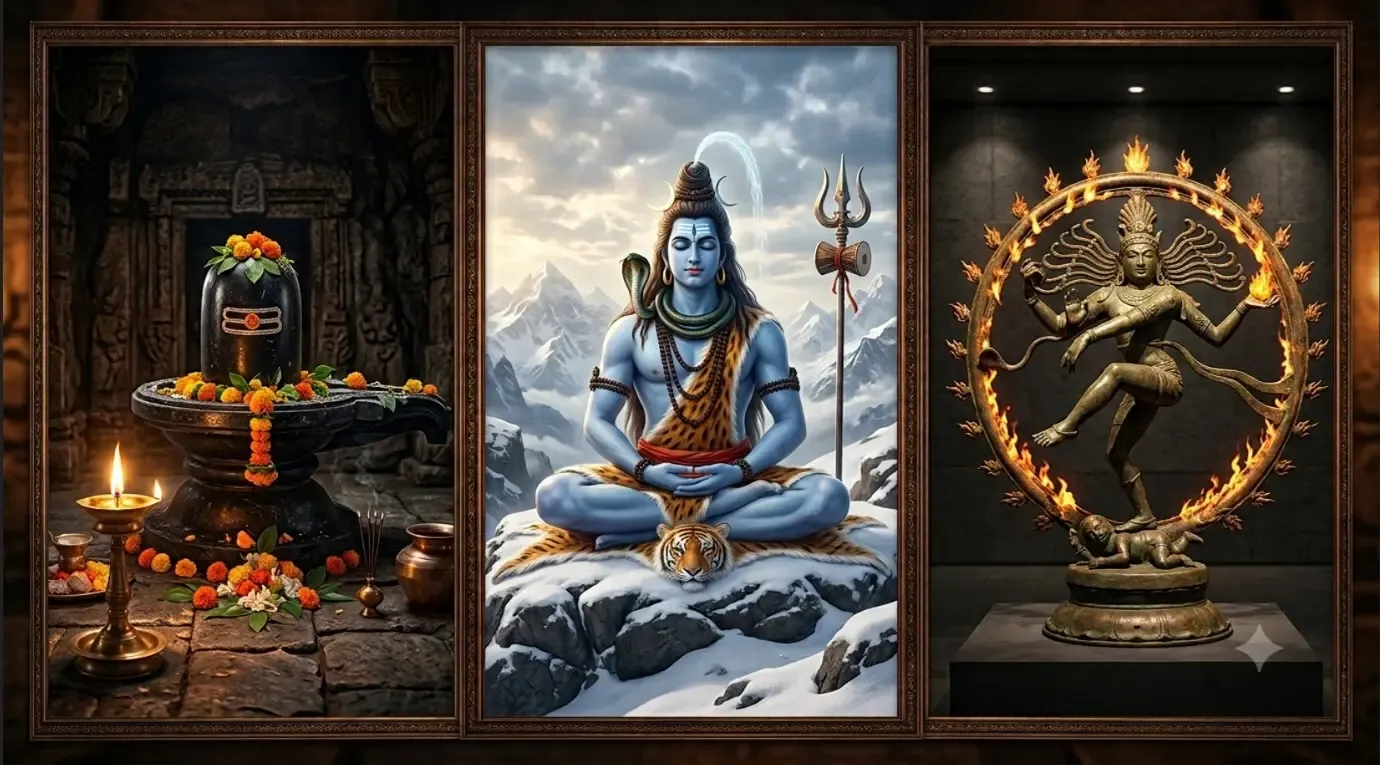
Walk into almost any Shiva temple in India and you'll notice something different about the inner sanctum. There's usually no elaborate face to gaze upon, no ornamented limbs catching the lamplight — just the linga, smooth and dark and silent, anointed again and again with water and bel leaves. Devotees have always understood this as deliberate. Shiva resists being pictured because, at the depth the tradition speaks of him, he isn't really a picture at all. He's the awareness in which every picture appears.
Within Shaivism, he's approached as the unmoving ground beneath all movement — pure consciousness, what the old texts callChit, watching the universe rise and fall without ever rising or falling himself. He doesn't act on the world from some distant throne. He simply is the stillness that makes it possible for there to be a world at all.
That stillness is never described alone, though. Shiva is always paired — inseparably, the tradition insists — withShakti, his own creative power turned outward and given a face of her own. If Shiva is the silent witness, Shakti is the one actually doing the dancing: she is time, she is matter, she is the restless energy weaving the world together moment by moment. Neither one makes much sense without the other, which is probably why so many of the oldest hymns address them almost as a single being wearing two faces.
It's in his withdrawn form on Mount Kailash — seated, eyes half-closed, breath barely moving — that this teaching becomes something you can almost see rather than just something stated. He sits there not because there's nothing left to do, but to show what's waiting on the other side of every distraction the world offers: that the self we go searching for everywhere else has, all along, never actually gone anywhere (Maya, the tradition calls that long search — illusion, or more precisely, the habit of looking outward for what was never lost).
Esoteric Iconography
Every element of Lord Shiva's traditional image carries its own teaching. None of it is decoration for decoration's sake — taken together, the whole figure works almost like a map of the inner life, drawn for anyone patient enough to read it:
Key Archetypes and Emanations
No single image holds the whole of him, so the tradition never settled for just one. Across the Puranas and centuries of temple worship, Shiva keeps reappearing in different guises — different enough, at times, that newcomers could be forgiven for not immediately recognizing the same god underneath. Three of his most enduring forms:
01. Nataraja (The Cosmic Dancer)
Picture him mid-motion, one foot lifted, hair flying outward in a perfect ring of fire, and you've pictured Nataraja — Shiva as the dancer whose every movement keeps the universe turning. The dance has a name, the Ananda Tandava, the dance of bliss, and it never really stops. Worlds form in its rhythm and worlds dissolve in it too; creation and ending turn out to be the same gesture, just seen from different angles. Explore Details →
02. Dakshinamurthy (The Supreme Teacher)
Here Shiva sits beneath a banyan tree, facing south, and says almost nothing — which turns out to be exactly the teaching. Surrounded by sages decades older than him, men who have read every text available to them, he answers their deepest questions about the nature of the self through silence alone, and somehow that's enough. Some truths, this form seems to suggest, were never going to survive being put into words anyway. Explore Details →
03. Mahakala (The Lord of Infinite Time)
Time, in most of our experience, is something that happens to us. As Mahakala, Shiva is the one time happens to instead — the lord standing outside its reach, presiding over the fire that eventually clears every age away to make room for the next one. It's a fierce image, deliberately so. Some endings, the tradition seems to be saying, are simply what allows anything new to begin. Explore Details →
These are far from his only faces. He appears asArdhanarishvara, fused down the middle with the Goddess to show that male and female were never really two things pretending to be one. He appears as Bhairava, fierce guardian of thresholds and burning grounds alike. He appears, in one of his gentlest forms, asPashupati, shepherd and friend to every wild and tamed creature on earth. Each face answers a different need in the people who turn to it — but ask any longtime devotee, and they'll tell you it's the same presence looking back at you every time.
Sacred Foundations
If you wanted to go looking for him in writing, you'd start with the Shiva Purana, which gathers his stories, his many forms, and the philosophy behind both into one sprawling text that devotees have leaned on for centuries. Alongside it sit theShaiva Agamas — more technical, more ritual-bound, the texts a temple priest is likely to actually consult before a major ceremony — and the ancientSvetasvatara Upanishad, whose verses on the one Lord standing behind all the named gods rank among the oldest philosophical writing Shaivism has produced.
You don't have to read about him, though, to find him. Walk the length of India and his presence turns up everywhere underfoot — most of all in the twelveJyotirlingas, the "pillars of light," scattered from Kedarnath high in the snow-bound Himalayas to Kashi Vishwanath on the banks of the Ganga, where the river itself is said to flow in devotion to him. Pilgrims have been walking this same long, footsore circuit for longer than anyone can date with real certainty — and they're still walking it today, in exactly the same spirit.
How He's Still Worshipped Today
None of this lives only in old texts. Monday is widely kept as his day across much of India, and Maha Shivaratri — the Great Night of Shiva, usually falling in February or March — is when his presence is felt most intensely of all. Devotees stay awake through the night, offering water, milk, and bel leaves to the linga hour after hour, fasting, chanting his name until the sound itself seems to take over the room.
The mantra most associated with him, Om Namah Shivaya, is deceptively simple — five syllables that the Tamil tradition calls the Panchakshara, "the five-lettered one." People chant it on long drives, in temple queues, under their breath at difficult moments. It doesn't ask for anything elaborate. Just his name, said with attention, is considered enough to begin with.
Many devotees also wear rudraksha beads — said to have formed from his own tears — strung into malas for counting japa, or simply worn around the neck or wrist as a quiet, constant reminder of who they belong to. None of these practices ask for a temple visit or any special learning first. That's rather the point. Of all the gods, Shiva has always been the one most willing to meet people exactly where they happen to be standing.
May the stillness he embodies find its way, even briefly, into your own day.
"Om Purnamadah Purnamidam... Shanti Shanti Shanti"