
Char Dham · Jyotirlinga · Island Shrine
Ramanathaswamy Temple, Rameswaram
Where Rama knelt before Shiva, where land ends and ocean begins — and a bridge of faith still connects them across the waters.
Overview
The Southern Axis of India's Sacred Geography
On the island of Pamban — separated from the Indian mainland by the Palk Strait and from Sri Lanka by a narrow strip of shallow sea — stands the Ramanathaswamy Temple, occupying a position of extraordinary importance in the sacred map of India. It is simultaneously one of the twelve Jyotirlingas of Shiva and one of the four sacred Dhams that devout Hindus aspire to visit in a lifetime — making it one of the very few sites that holds supreme sanctity in both Shaiva and Vaishnava traditions.
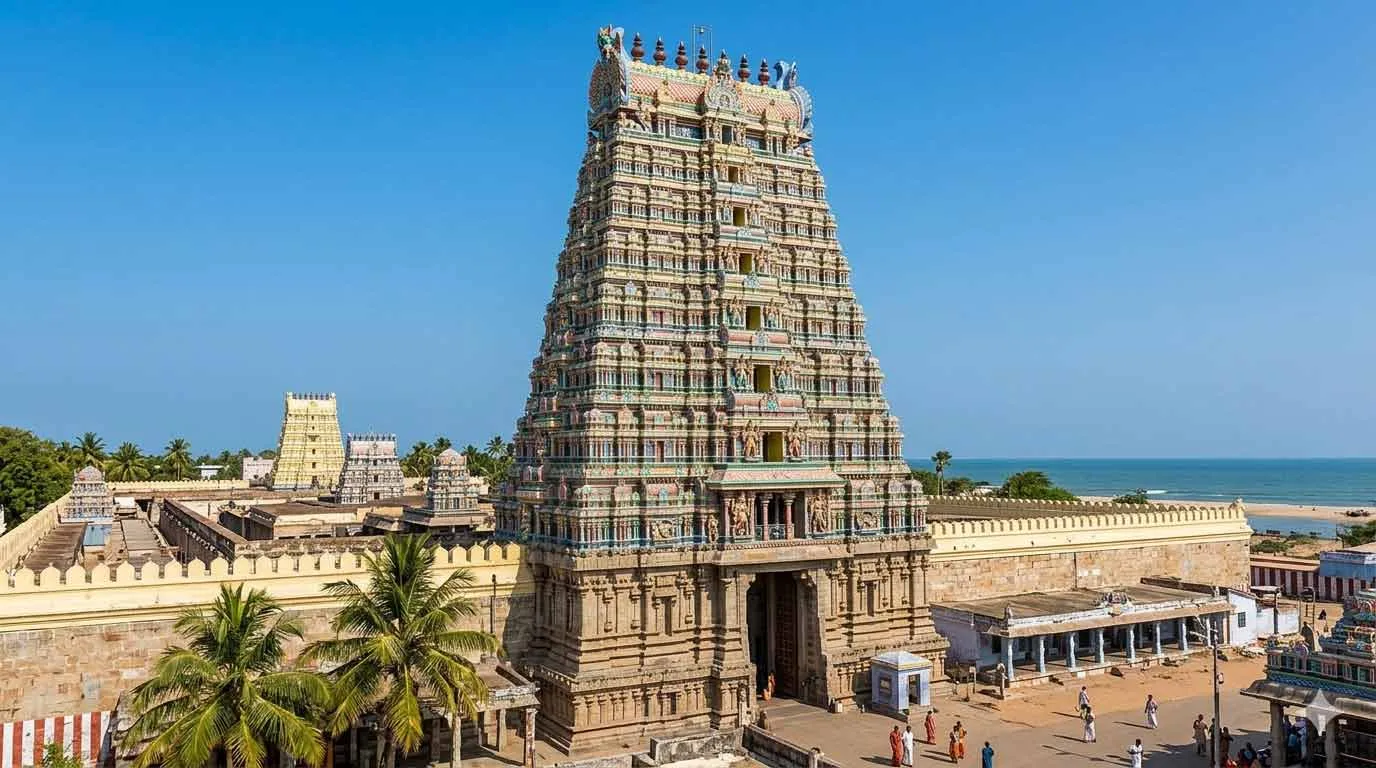
The temple's setting gives it a quality found nowhere else: an island temple at the confluence of two seas, at the southernmost accessible edge of the Indian subcontinent, in a landscape of white sand, salt wind, and pellucid water that feels both remote and deeply familiar to those raised on the stories of the Ramayana. For it is here, according to that most beloved of epics, that Lord Rama himself stood before setting across to Lanka — and here that he returned in gratitude and worship.
History
Centuries of Sacred Construction
The earliest structural temple at Rameswaram is attributed to the Pandya kings, who held the region from ancient times and regarded the site as one of supreme sanctity. Subsequent rulers — including the Setupatis of Ramanathapuram, who bore the hereditary title of guardians of the Sethu (the sacred causeway linking India to Sri Lanka) — contributed progressively to the expansion of the complex over many centuries.
The most distinctive feature of the temple — its extraordinary corridors — was largely constructed between the twelfth and seventeenth centuries, with the magnificent outer corridor (the longest in any Hindu temple in the world) added in the seventeenth century under the patronage of the Setupatis. The renovation and maintenance of the temple has continued into the modern era, and the complex today reflects the accumulated devotion of rulers, communities, and individuals across more than a millennium of sacred construction.
Architecture
The Corridors That Go On and On
The Ramanathaswamy Temple is justly celebrated for its corridors — the longest in any Hindu temple anywhere in the world. The outer corridor stretches for approximately 197 metres on its longer sides and 133 metres on its shorter sides, supported by over 1,200 ornately carved pillars that create a processional colonnade of stately, almost hypnotic beauty. Walking the full circuit of these corridors — a common act of devotion — covers well over a kilometre, and the play of light and shadow through the ranked columns at different times of day transforms the space continuously.
The temple has two principal Jyotirlingas: the Ramalingam, believed to have been installed by Rama himself, and the Vishwalingam, brought by Hanuman from Kailash when the Ramalingam was being prepared. Both are worshipped with equal reverence, though tradition holds that the Ramalingam takes precedence. The gopurams at the eastern and western entrances are particularly grand — the eastern tower rises to approximately thirty-eight metres and is encrusted with the ornate sculptural programme characteristic of late Sanatana architecture.
At Rameswaram, the worshipper of Vishnu and the worshipper of Shiva kneel at the same threshold — for it was Vishnu's own avatar, Rama, who consecrated this Shiva shrine. The two great streams of Hindu devotion meet here at the edge of the sea.
Spiritual Significance & Legend
Rama's Act of Gratitude and Atonement
The Ramayana describes how Lord Rama, after his long war with Ravana and the rescue of Sita, paused at this island before the return journey to Ayodhya. The sages advised him that despite the righteousness of his cause, the act of killing — including the killing of Ravana, who was a brahmin — carried a spiritual burden that needed to be addressed through worship of Shiva. Rama decided to install a Shiva linga at this sacred spot and sent Hanuman to Mount Kailash to bring back an appropriate one.
Hanuman, devoted as he was, took longer than expected on his journey, and the auspicious moment for the installation was approaching. Sita fashioned a linga from the sand of the beach herself — and it is this sand-formed linga, the Ramalingam, that became the primary object of worship. When Hanuman returned with the Kailash linga (the Vishwalingam), Rama honoured his devotee's effort by installing it alongside and declaring it equally sacred. This act of divine grace — honouring effort even when superseded — is one of the most warmly remembered details of the Ramayana and gives the temple its dual-linga arrangement.
Pilgrimage Guide
Visiting Ramanathaswamy
Best Time to Visit
October to April offers the most comfortable weather. Mahashivaratri and Rama Navami are the major festival occasions at this temple.
The 22 Theerthams
Pilgrims traditionally bathe in all 22 sacred wells within the complex before entering the sanctum — a purificatory rite central to the Rameswaram pilgrimage experience.
Nearby
Dhanushkodi (the ruined town at the island's tip), Agni Theertham (the sea bathing ghat), and Pamban Bridge — one of India's most scenic rail bridges.
Getting There
Rameswaram has its own railway station connected by the historic Pamban Bridge. Nearest airport is Madurai (170 km).
Jai Ramanathaswamy
May the Lord who received Rama's worship at the edge of the sea bless all pilgrims who walk his ancient corridors with devotion.